My Upcoming Autism Memoir
Over the course of this year, I have mentioned in passing, both here and on my Facebook Author page, that I’ve been working on a memoir. Now I can announce it should be ready on Amazon Kindle (and other ebook places) by the middle of next week. When it is ready for purchase, I will post the link here on my website in the “My Books” section as usual.
A Fear of Butterflies: My Autism vs. Capitalism is what it sounds like. It will be a brief “memoir of eras” in my life as I call them in the text, summarizing how much my constant social and professional struggles from childhood onward can be traced back to my brand of Autism, even before I knew I had it. I use the stories of my difficulties in all eras of my life both as a means for the reader to get to know more about me, and to elucidate just how stacked against me and people like me, our American society, with it’s myths of meritocracy really is.
The latter half of the book is also autobiographical, but deals with specific useless advice I have gotten the most from many different corners, all ineffectual and dismissive when taking the burden of neurodivergent masking into account.
It is by an Autistic man, for other Autistic people, so they may recognize themselves in my story, when perhaps they have never recognized themselves in any body else’s.
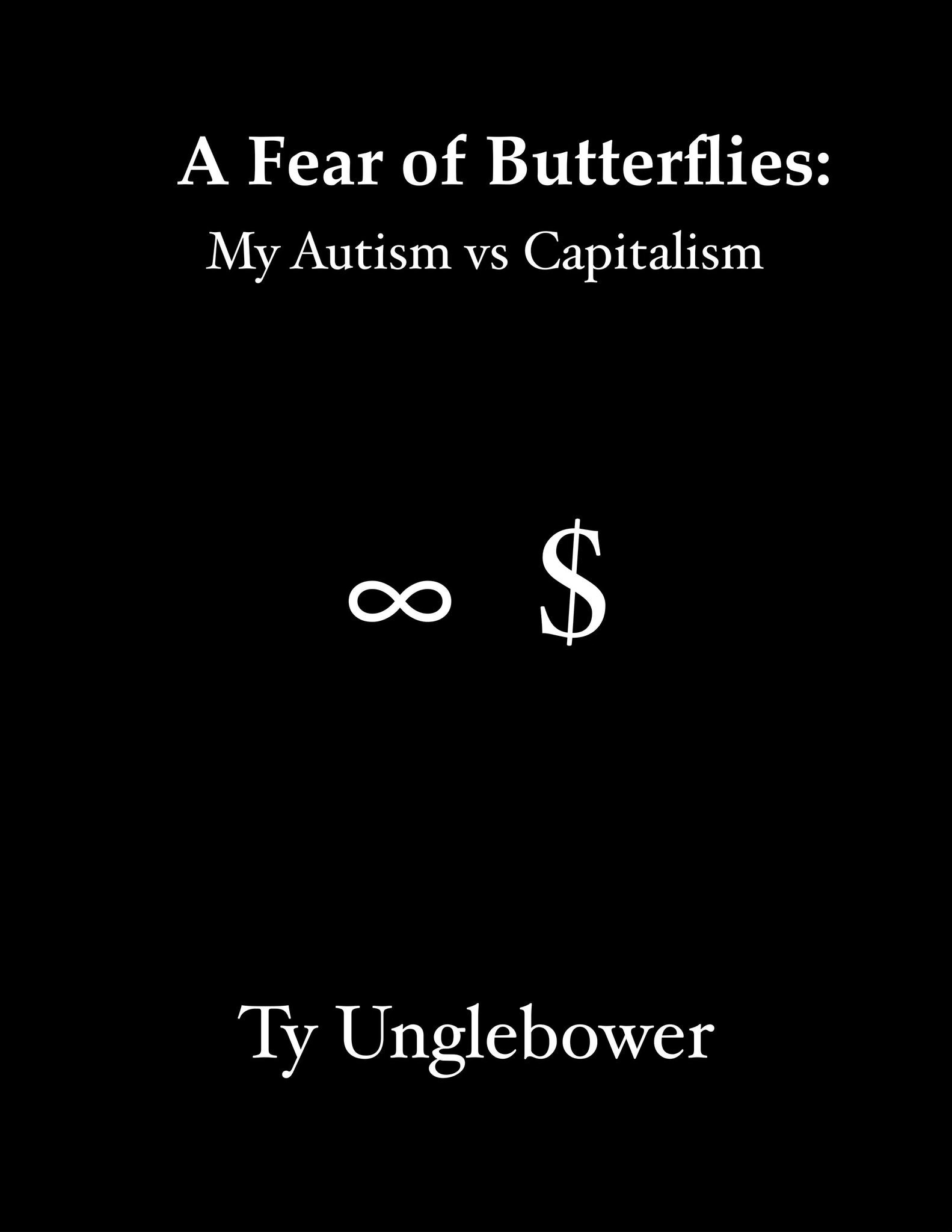
I am not adept at marketing in this culture, and part of that is because of the very Autism I have mentioned. It was one of the reasons I wrote the memoir to begin with. And now that I am faced with the ironic but necessary task of marketing and promoting a book about how impossible it has been for me to promote anything (including myself) I have unconventional decisions to make. Such as the above minimalist cover for the book.
And the (hopefully) affordable price of 3 dollars for the time being, so many in my position can have access to it. (Another reason it is not yet in the more expensive paperback format, though with time I will make one available, I think.)
If anything I have written here or elsewhere has mattered to you, I hope you will spread the word about ,y memoir to those you feel would get the most from it. Word of mouth is after all the best of the promotional and marketing activities.
More to come.
Arts and American Fascism.
The recent United States presidential election has not only permitted a Fascist to assume power once again over the nation and its resources. It has proven that just under half of the citizens of this nation are in diametric opposition to democracy and wide-ranging human freedoms.
There are in short, tens of millions of evil people on this continent. If not the majority, certainly the majority of those who bother to participate in voting, which is just as lethal to our society.
It is a horrifying turn of events, that only fools and people paid to think otherwise could not have seen coming, numbers notwithstanding.
Since the moment this nightmare future for decent people was confirmed for us, I have advocated against joining organized, vocal resistance movements to oppose the inevitable American tyranny. Not out of a sense of capitulation, but out of a sense of safety, and a recognition that those who are both honorable and motivated to act are outnumbered to the point of ineffectiveness. Such movements have failed to stop our national march into hell before, and they will again. Nothing about the reactions I have seen over the last two weeks indicates it will be different this time.
I believe being part of these movements only puts a target on one’s back, while failing to accomplish a single noble goal. I’d love to be wrong but I do not think that I am.
That being said, I don’t advocate surrender.
We must now more than ever embrace diversity, as well as the arts and humanities. We must write and read and perform and sing twice as much as ever we did. And we must do so with twice as many different types of people than before.
Hoard books. Print out studies. Hide magazines. Lock away movies and documentaries. Bring art into whatever fortifications you have. Keep all of the above safe in whatever way you can.
Go underground for shows and concerts if it comes to that. Do not stop either the creative act, or engaging and consuming the creative act of others.

Science, as noble as it is, has lost its grip on the overall control of this fallen society. The arts and humanities may not have the instant impact of engineers and environmentalists, but they are the only thing with a chance of saving our collective souls, or at this point, the souls of our children who may live to see a post-Fascist America. Maybe.
I will continue to write what I wish, and read what I want, if and until I am physically prevented from doing so, even if I am not marching, giving speeches, or canvassing. I strongly advise you do the same.
The Delusion of the Artist
Anybody who writes anything beyond a private diary has some degree or arrogance, delusion, or both.
I include myself in this. I am somewhat deluded as a writer. I like to think more deluded than arrogant.
Don’t worry though, if you happen to be a writer. I don’t think these need be permanent, or even prominent traits. But think on this: the moment you hope somebody out there in the world wants to listen to things you made up and/or things you think, you are embracing at least some arrogance. The miniscule assumption that words you put together at home will be worthy of the attention of others in an attention-diminishing world. And I am not even referring to becoming rich and famous; anybody who has written knows that it’s sometimes a small miracle to even get a few friends to ready your stuff.
(My thanks once again to those few who read mine.)
I often come back to the proposition that if one knows there words and stories and ideas will never be considered by another person, they might as well save time and energy, and leave them all inside one’s mind.
The spiritual pilgrimage every writer, indeed every type of creative must take at some point, in order to find contentment, is the realization that it is the process of creating that is the focal point of a life of scope. Popular or not, the very fact you create something is a certain meditation against the very nihilism and fruitlessness that can creep into your mind when nobody does take an interest.
The universe has one more creation in it because of what you do. Even the enormity of everything we know is added to if you create. It’s external, even if not eternal.
You won’t feel this wisdom all the time. I don’t. In fact, only maybe a third of the time can I tell myself that the creative act itself is the balm on the cold dark wound of being alive in today’s world…and that while worldly success could provide much needed money as well as a gratifying sense of lightening the hearts and engaging the minds of readers, it cannot be depended on. There is too much luck involved for that.
I don’t always want to create. Neither do you, and it’s fine. We adopt nothing to our gain if we guilt ourselves for our failures to gain it.
And if a tiny bit of arrogance here and there gets that noble ball rolling enough to continue once the dust settles, so be it.
The Tempest in a Teapot
I can write two books at once, and have done. The caveat is that one has to be fiction, the other non-fiction. They occupy parts of my mind distinct enough from one another to cause no issues.
Outside of this arrangement, I won’t write more than one book at a time. One will inevitably suffer if I write say two novels at once–the required commitment is diluted.
Even if I go a month without working on a novel, I am committed to it so long as I do not move to a different story. If I started a new story every time the notion of one occurred to me, I would simply never finish anything. Discipline!
For my occasional non-fiction, it is the same.
I also avoid double-ups in my theatre life. A play is not as constant or for as much time as writing a novel. But arguably it requires a tighter, more intense focus on any given day or week than the writing of a novel does.
And it happens on someone else’s deadlines.
Not to mention what one owes the rest of a cast and crew.
No. I very much don’t screw around with plays. I am in or I am out. No half-assing it.
To be in two plays as once has happened once before in my life…until now.
As I am in rehearsals for Arthur Miller’s A View from a Bridge, as Alfieri, I have been cast in Shakespeare’s The Tempest, as Sebastian.
(Those who follow me regularly will note that my current novel, The Rubble and The Shakespeare happens to tell the tale of a group of people attempting to perform this very play. )

Which means there will be some overlap in rehearsals. This is mitigated to a certain degree because both plays are at the same venue. Had the second play been elsewhere, I doubt I would have auditioned for it.
For me, this is not best practice under normal circumstances.
But it wasn’t normal circumstances. Shakespeare is so infrequent on the community stage, especially in my area, I grab the chance to perform it when I can. I doubt there would be any other playwright that would encourage me to double in this way.
It will require greater focus, dedication, and an appreciation of the process of storytelling than being in a single production requires. Handled poorly could invite a certain irony–the art would diminish the creativity through sheer volume.
I am determined to avoid this, of course. If anything, I want to use this temporary double-up to encourage enhanced mindfulness while rehearsing one over the other. The now, and the moment of the creative act must be priority, both on the Miller days and the Shakespeare days, until the former is concluded and I can throw myself totally into the latter.
This is not something I want to do often. But as I am in it, the deliberation and thought for process can attain a rare depth, if I am motivated to make it so.
And I am.
The Five Pages Rule
I’ve mentioned before I rarely read books of more than 400 pages. I realize that to some I am missing out on many potential great stories. But as I am, and have always been a slower reader than average, (probably related to Autism…everything else is!), I have to be choosey about length if I don’t want to be reading the same book for two or three months.
Every few years I’ll attempt an epic-length read if the premise appeals to me. Most of the time it’s worth the effort somewhat tiring effort. Sometimes it isn’t. (I couldn’t get into The Priory of the Orange Tree, my most recent attempt at a so called “brick.”)
In truth, it isn’t so much about the number of pages. It is about the speed of most pages in said book. Something I call The Five Pages Rule.
Not a revolutionary idea. Quite simply, it’s a matter of how quickly I can read through five pages, about three-quarters of the time.
One reason I shy away from epic-length books is that any given five-page sliver is so damn slow.
I get it; this is often done on purpose. The author seeks to establish the proverbial “slow burn,” provide an immersive experience to the reader. Legitimate style choices, those. However, it isn’t a style I have been able to consume a regular basis. The snob in me wishes I could read either faster, or enjoy more the painstaking nature of such reads, but if I have not developed either trait by this point in my life, I am not likely ever to do so.
Nor is it limited to sagas; some of the slowest books I have ever tried to read were less than 200 pages total.

The audiobook I’m listening to, (due to an error on my part) is longer than I thought it was when I checked it out–might approach 500 written pages, rough guess. But I have not as of yet set it aside, because most “five pages” move quickly as I listen.
No doubt the narrator plays a large role in this. Not to mention, I can get through any audio book faster than any written book–most people can. More is forgiven when listening to a book than when reading it, I can’t deny that.
Yet there is only so much even the best readers can do for a book that is “written slow.” If the pages of this longer-than-my-usual read were slowly paced on paper, it would have bled into the narration. It has happened with plenty of my other audio DNFs over the years.
I don’t suggest every page of every book must be lightening fast. Paces are supposed to vary. It’s not so much speed but smoothness of read.
And of course even good books hit lulls sometimes. My oft-mentioned habit of given any book 50 pages to catch my attention still stands, usually. But within that 50, if there are more 5-page slogs than 5-page sailings? Probably headed toward DNF island.
Audio or not, if more books in the 400+ page range concerned themselves with how fast a reader gets through five pages at a time, instead of focusing only on the long game, I’d consume far more such books, more often than I do now.
As an author myself, I usually strive for faster pages the average in my fiction. One cannot fully judge the success of one’s own work in this regard, but I have it on my mind every time I write, despite all my novels being under 400 written pages thus far.
My current work in progress, which I began a mere few weeks ago will almost certainly end up with more written pages than anything else I have written. I went into it knowing it may be near-epic length by the time it is finished. That’s why I’m all the more cognizant of just how fast most of the five-page-slivers will read.
Why five pages? No hard and fast reason. I think that any book I am likely to enjoy on the whole will string together five good pages more often than not. But for some it could be 10 pages or 30 for all I know. It depends on how much and how fast one reads. The point is, when you have to read slow, and in shorter sessions such as myself, having most of your smaller pieces packed full of memorable writing that is a joy to get through, you make up for the slower parts.
If I find an author of longer fiction that does this, I may just read more of those popular doorstoppers.

 Ty Unglebower