Oil Painting
I’ve always wanted to know what oil painting was like. A few months ago I was determined to try it out on at least a limited basis.
The universe encouraged this experiment by making oil painting supplies discounted all at once in a store I visited about a week later. So of course, I bought them up. That was November. Since then I’ve painted about ten small canvasses.
No lessons. Not research. Just going for it with abandon. Lots of learning as I go. Lots of experimentation. And lots of mess. (Despite the use of mineral spirits for thinning and clean up, my bathtub looks like a used palette. I’m still working on an efficient cleaning process.)
I like the feel of the brush on the canvass. (Or in some cases the wood/particle board I had lying around.) I like the consistency of the paint, the thick, creaminess under the brush. The blending of colors both on the palette, and on the canvass itself. I like seeing obvious brush strokes on the finished product, knowing that I’m looking at a painting , and that the strokes of paint are my own.
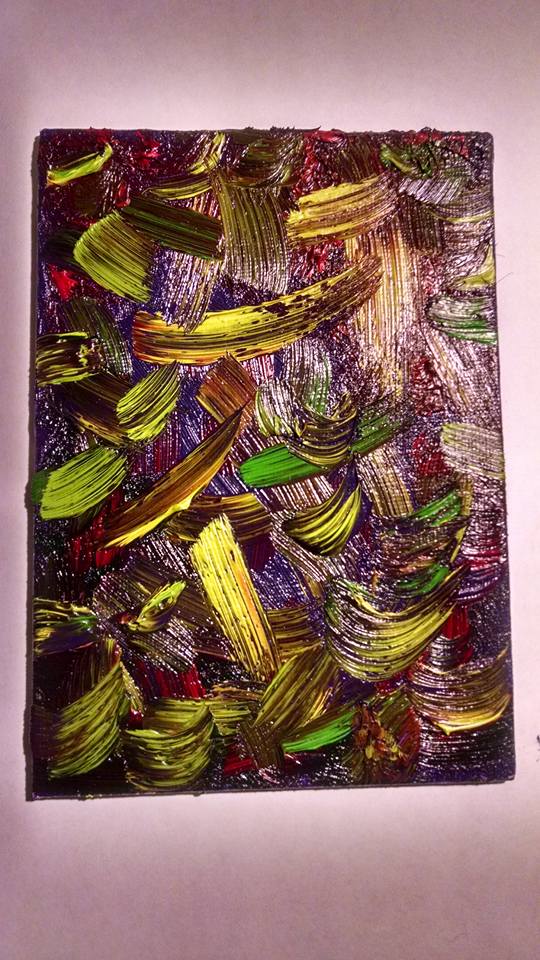
“U-Turn” oil on canvas
Due to most of the canvasses being tiny 5′ by 7′, I tend to finish in one sitting, not knowing until I’m in the middle of the project what sort of look I’m going for. Not being trained, I have to work with how the paint is presenting itself, because I lack the skill and knowledge to know how it will behave before I begin. I mostly enjoy the not-knowing.
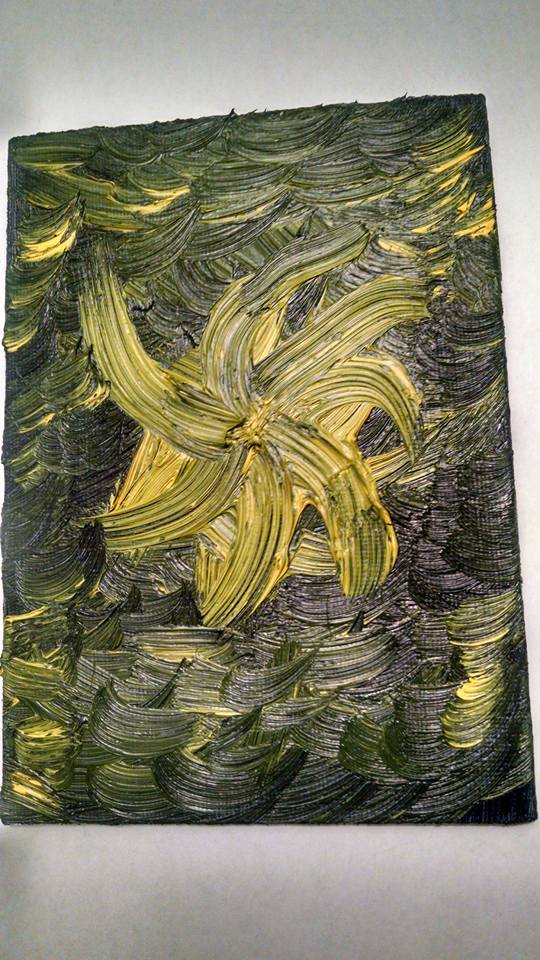
“Tenacity- oil on canvas.
It may not be predictable when I paint, but it is in many ways instant. Not as instant as photography, but nonetheless I am immersed in the creative process, albeit haphazard, as soon as I begin. I can see that this action I take has right away brought about something that seconds before did not exist. That something is art. My art. Not great art, not marketable art, but my own art.
And it’s mostly abstract art, as I lack the skill to sketch or paint actual objects, though the first painting I did was of a roughly sketched cottage, and it sort of looks like one.
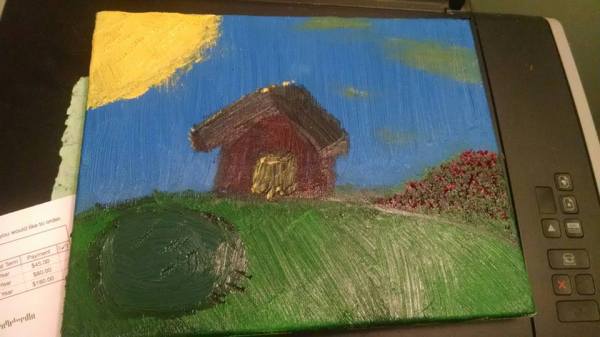
“Cottage Near Roses” -oil on canvas
The rest of the paintings have several aspects to them that came about because the paint didn’t behave how I thought it was going to. Some of the cooler images have come about in this manner.
I am a writer, and not a painter. I don’t see myself becoming a true painter, as opposed to someone who enjoys painting. (Note the difference.) But when I need a break from the slog that creating a finished work of writing can sometimes be, painting can be one of the antidotes for a while. No description, set up, exposition needed. I draw a brush across the whiteness, and right away, if you were watching me, you’d see something I created in an infant stage without the need to settle in, as reading words requires.
But I’m not thinking of you when I paint. I’m thinking of me. Actually, I’m not thinking at all. I’m just painting.
Exeunt Dionysus
If you have been to this blog on a regular basis, follow me on Twitter, or just know me personally, you know what Flowers of Dionysus is.
It’s my first self-published novel, and the first novel I carried into completed drafts. It’s the story of a talented but disillusioned community theatre actor, Matt, called back into service at the request of a dear friend of his. Unexplained events and odd encounters with some eccentric personalities lead Matt and some of his new friends to reevaluate themselves, theatre, art, and maybe just maybe the purpose of life itself.
The inspiration for it came to me in a sort of flash, and I spent the better part of two years transforming that inspiration into a rough draft of a novel. Four years and about 7 revisions later I put it up for sale for what I thought was a reasonable price.
A few friend bought it, but almost nobody else has. I remain disappointed that I never reached even the most modest end of my goals for reaching and touching creative-minded artists and actors such as myself with the story I tried to tell with humor, honesty, creativity and love.
It’s now available for free.
And there is one other thing about Flowers for Dionysus. It’s my former project.
It’s over. It’s written, self-published, and available for download for anyone who would like to read it, (and I hope some day you will.) I will continue to mention it over time as part of my body of work.
But as I ready my as yet untitled Mystery Novel for the next round of revisions, and then in a few months start the meticulous task of formatting it for self-publication I have to face facts. If I have any hope of building a platform and a body of work as an author, the new book needs my attention and creativity now. In revisions, in edits, and in (hopefully) a more effective marketing strategy. I need to talk it up, project my interest in it, and make it the main public focus of what I’m doing as an indie author.
In short, Mystery Novel must take the spotlight, while Flowers of Dionysus steps back, and takes it place on my shelf, as it were. It is no longer “the novel,” no longer the “work in progress.” Though this has all been true for months now, given the lack of interest among many people I know in reading Dionysus, I am only now stating it in conclusive terms. For the first time in years, Flowers of Dionysus is not the flagship of my creative writing endeavors. It is part of me, and part of me is in it of course, but I now face the somewhat sad and ever so slightly surreal truth that it’s not about that novel anymore.
The first novel I ever worked beyond a second draft. The first one I let non-family read. The first one I sold, (even to just a handful of people). The one that came from a different place than most of my writing has come from before or since…is yesterday, and it’s a bit difficult to accept.
It could of course take off some time in the future. It remains available and will continue to be so. That’s part of the beauty of indie e-publishing. If that happens, I will happily lead the charge on its behalf again. But even so, I will by then, have other things to take care of, edit, promote, sell. (Or try to.) It will never again be the near-exclusive centerpiece, I imagine.
But it will always be unique in my life. Always special. Always sentimental and spiritual in a way most of my other work, past, present and future will probably not be. I hope to write special things again, deep things, important, moving things that matter to people. But part of me inside will likely always hope that future satisfied readers will give my first novel a try as well, because I doubt I will ever be able to spend that much time on one novel again. I doubt I will feel the message as early or as particularly or as urgently as I did for the first one.
Then again, I might. But Flowers for Dionysus will always be the first in this regard, nothing, be it poor sales, lack of interest from my people, or the march of life and my career into the future will change that.
As a character in the novel says, “You’re never alone when you do something you love.”
I love that novel, flaws and all.
Support Indie Authors
I’m an indie-author so far. I publish my own work. That brings special difficulties. Any indie author is aware of this, at least in the start, and we need all the support we can get, especially from one another.
I’m choosing to do that as a reader by eliminating the separation between indie-published works and traditional published works. I won’t read a book simply because an indie-author wrote it. nor will I take the route of some indie authors,and swear off reading traditionally published fiction entirely. Rather, when it comes time for me to read something new, I plan to survey both traditional and indie-published works in order to make my decision. There will be no “turn” or “special month” for indie-reads.
By doing this as a reader, I’m bringing indie authors into the sphere of just “potential reads.” Not as a favor to someone I know, and not hoping for a favor in return, but remembering, consciously to see authors as authors, books as books.
That’s what I want for my own work. While I’m thrilled with any reader that enjoys my work, I don’t want someone to read my novel(s) just because I published them myself. The solidarity with indie-publishing would certainly be appreciated, by me and others. But I am first and foremost a writer of stories, and it is stories I want to be known for, not for how I published them myself.
It is by seeing indie work as being just part of a reader’s options that in a sense helps the cause more than singling out indie authors. It “normalizes” us. It brings us into the author fold, from which we are often kept by nothing more than artificial constructs of snobs and those that stand to lose financially from the indie-book movement.
We indie-authors do need specific help in all kinds of ways. But by seeing each others work and just more potential good story telling that catches our eye when it comes time to be readers, we take a step closer to normalizing ourselves, even if society as a whole hasn’t done it quite yet. (It’s coming, for sure.) If we cross-pollinate our tastes, reviews, recommendations with traditional fiction, we inspire growth more so than just sticking to our own kind.
Plays vs. Novels
Among my creative goals for 2016 are revising two novels, (in two different stage of completion.) I am also revising a stage play, which hopefully will get at least a local reading before the end of the year.
Revising plays is so much different from revising novels. Both have their tedious qualities, and both have their satisfying aspects.
The easier part about revising novels is the amount of real estate to work with. If a scene isn’t working, I have the freedom more words to shuffle around. I can work the description, change dialogue, give myself more time to get to the point if needed. (Without boring the reader, hopefully.) In short, a novel allows me to meander to some extent. Fixing something that doesn’t work can happen in more than one fashion.
In a play of course, I generally don’t have that option. A play is almost exclusively what people say. I’m very much opposed to pages-long descriptions of sets and characters and actions for a script. As an actor/director such meticulous detail gets in the way. It’s obnoxious. I call it “phantom directing.” If a playwright wants to control the mood and the look to that extent, he ought to move into novel-writing, where in essences the writer controls everything on the page. (Though character’s do tend to dictate their own arc at times.)
The same goes for stage directions. If there are more than two sentences in a script at a time explaining movements and actions of actors, the playwright is too insecure, or hasn’t done their job.
When I write a play, (and i have only ever written three, two one-acts and a full length) I keep description and stage direction to a minimum. About 90% of character, motivations, sequence, tone and all such things are revealed directly through what characters say on stage. When something isn’t working for me in a script, most of the time, working on dialogue is my only recourse. I can change the sequence of scenes, somewhat, and maybe add one or two clarifying stage directions, but I can’t hope around location to location, or in and out of someone’s thoughts with ease, as I can in a novel. I have fewer means of “attack” when I revise a play.
This disadvantage of revising a play is however also its advantage. I don’t have as much to juggle. When writing or revising a novel, one can never really be “off” on the page. Every pause must be described, every sight and sound at least somewhat explained. No moment in the arc of a novel escapes scrutiny when it comes to diction, word choice, sentence length, and so on. That’s a lot of sentences to take care of, each one with a different purpose. That means I have to switch my “ear” to tune into different aspects of a novel at any given point in a rewrite. Am I doing character here, or description, or dialogue?
In a play, I need only worry about how the dialogue sounds. It may take me a few tries to get it right, but it’s the only thing to which I’m dedicating the word craft. If Bob leaves, I put Exit Bob and am done with it. No exploration. No poetry. No symbolism. If I need Bob to get out, I state it, and that’s that.
In a play, the thunder doesn’t have to “roll over the sky like an ancient boulder scraping along and gathering steam over its mother mountain, on it’s way to oblivion.” In a play it’s. “Sound of thunder.”
I love writing good prose, even if I’m not usually fancy with it. But the novelist in me still enjoys the break he gets when I am revising a play.
It’s different for every writer of course. Some may not see these aspects of revising as positives. I also would surmise at this time that over the course of my life, I will have written more novels and stories than plays. Still, while spending time on one, it helps me to remember the distinct advantages one has over the other.
I try not to dwell too much on the distinct difficulties of each; writing is difficult enough as it is.
Do you write plays and/or novels? Which is easier for you?
My Thoughts on Sex.
In my fiction, that is to say.
Or, that is not to say. Sex has never appeared in any of my fiction. Then again, neither has Prague, backgammon or millions of other things. Yet I’ve found a noticeable difference between the reactions to never including sex in my work, and never including the other things.
If you tell someone you have never written a story that takes place in Prague, they aren’t likely to think much of it. Some might say, “So?” Other writers might say, “I guess Prague just isn’t vital to the stories you’ve wanted to tell.”
Say that that has never been any sex in your fiction, and you get, “Wow, really? Do you write kids books? Christian fiction? No? Okay, well…”
The lack of sex, or sex scenes in my fiction is not a purity or religious issue. Sex is not dirty or immoral to me. The sexual urge is almost as universal as the need for food and water and warmth. Embracing it, denying it or describing it is an element in many stories, true and fiction. In fact, so universal is it, that I have read articles over the years, and had conversation with people who say that adult fiction of any kind simply cannot be believable unless somebody, somewhere in the story is dealing in someway with sexual tension. That every plot, on some level, can be boiled down to sex in some fashion.
Think again, Sigmund.
Every writer tells certain stories at any given time. To do so successfully, certain things must be revealed certain things must be hidden, and certain things can be assumed. As they say, if something is not revealing character, advancing the plot or setting a mood, it’s usually extraneous. In the end, the stories I have felt compelled to write are not moved forward by describing sex. The characters I have written reveal themselves in actions that are not sexual in nature. The moods of my works can’t generally be described as erotic. So, why would I write sex scenes into my fiction, if they would so clearly exist only for their own sake? Because sex is important to everybody, everywhere, allegedly? I imagine urinating is as well, and it isn’t described in detail in most novels I’ve read.
“This ‘Flowers of Dionysus’ contains no DE-flowering. Unglebower, you prude.”
Yet you know all the people in a story at some point urinate. (At least outside of odd science fiction tales.) Just as you can assume that certain people have sex at some point. This is true with my own fiction. I don’t write only celibate characters; a lot of people in my fiction can be assumed to have had sex at some point in their lives. I just don’t need to visit them, as an author, while they do so, in order to tell the story I want to tell.
Will the time ever come when I do write a sex scene into my story? Maybe. Never say never. But the angles at which I approach stories don’t usually lend themselves to sex scenes.
I did try to write a sex scene once, though. It was a stand alone scene that I wrote for an erotica author friend of mine to take a look at. They didn’t hate it, but it wasn’t very good. I shared it with one other writer of such things, and they too didn’t hate it, but didn’t love it either. So for no other reason than I am not any good at it, perhaps I will leave sex scenes to the professionals, like my various author-friends.
As for Prague and backgammon, I wonder if there is a novel to be created around a backgammon tournament in Prague…wherein nobody has sex.

 Ty Unglebower