Looking Back on My First Book Fair
A few days short of one month ago, I had my first ever author booth at book fair. It was the Love Books Festival, in Lovettsville, Virginia. With the passage of that month, and some time to let the experience sink in, I’m now ready to offer some overall thoughts on what it was like.
I have to start with a disappointment specific to the event itself. It was the first time this group attempted an event of this nature, but there was little to no communication with the authors. It was a first for me too, but other than my name on a tiny place card on the table in the gymnasium, I had no guidance. I just carried in my stuff at set it up.
Nobody from the event ever came round to introduce themselves or ask if we, the authors needed anything. I didn’t happen to need anything, but not being asked made me feel like a number on auto pilot.
It was my first time ever creating a display of this nature. I’d say given my budget, I managed it well.
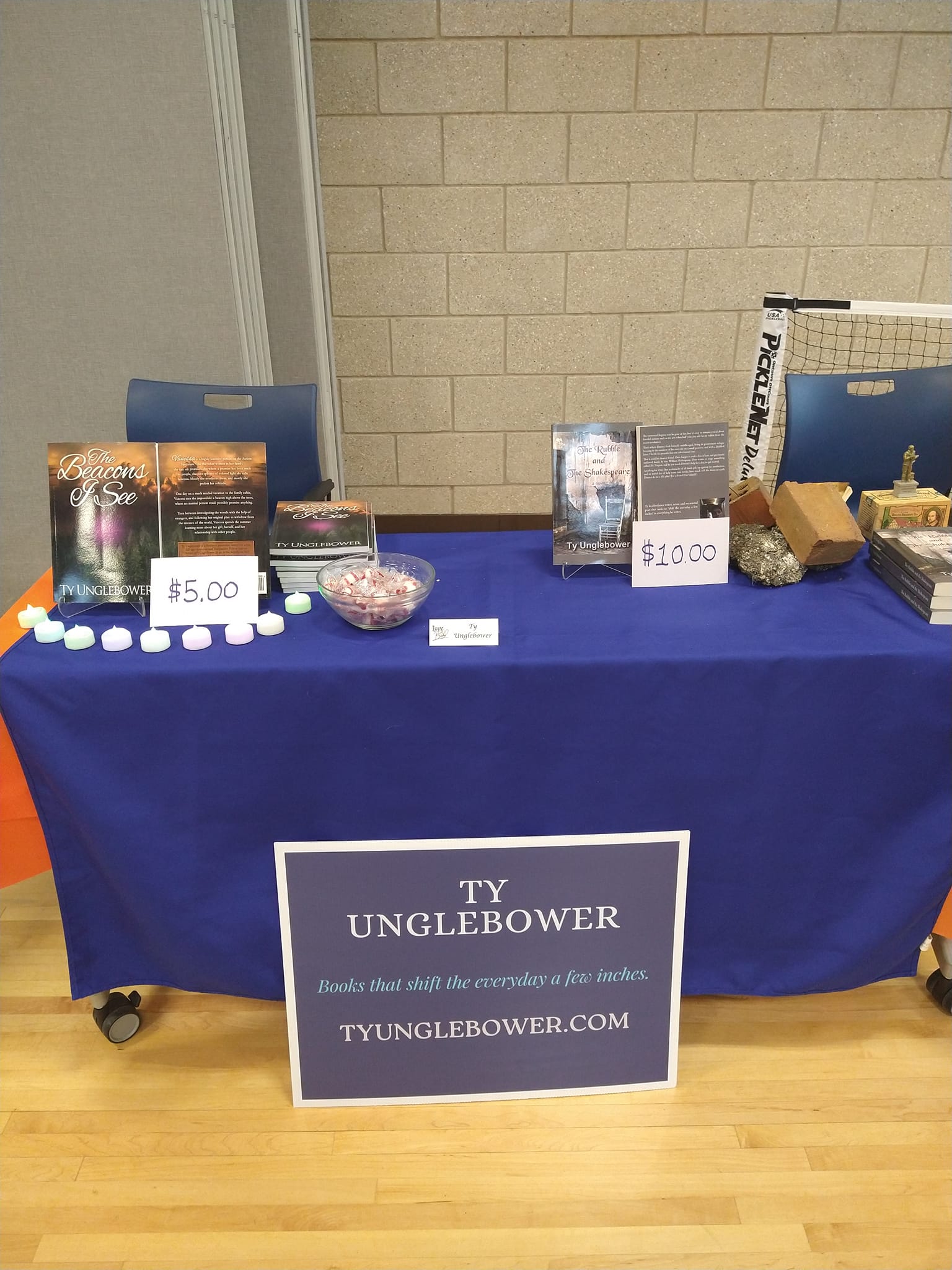
Sadly, I sold only a single book. It wasn’t;t even my most recent book.
Part of it was probably the newness of the event, for everyone not just me. Nevertheless there were a nice stream of people for most of the afternoon. And I did get a few nibbles, but only the one sale.
I left about 30 minutes early.
The guy two tables away from me literally was calling people into his booth in a hard sell. “Hey you with the red shirt, you like rocks? Come here, want you to see something.”
Gauche, in my opinion. But even if that is the expectation, that was never going to be me. My books don’t invite themselves well to such a pitch in the first place, even if I didn’t find that approach obnoxious.
Half of the venders were selling kids books. Far be it from me to claim expert marketing knowledge, but in my mind, kids books and adult books should be at separate fairs, or in the very least separate rooms at the same fair. The nature of the customer and the author differs substantially, and I hypothesize having so many kids running around looking for free stuff looks away at least some of the oxygen from adult-book authors who might otherwise have found themselves in useful conversation with potential buyers.
Or one another. As it stood, my neighbor on one side never showed, and almost none of the other authors made rounds to other tables, so I met nobody.
Overall, while I was technically not as adrift in a glut of authors and books at this fair as I am on the internet, I still felt quite alone and unseen. Worse, I can think of no approach that would change this, beyond not having kids present, and that is speculation at this point.
If I did this again anywhere, I believe I will look for a category specific book fair. A fantasy fair, where people are at least looking for the sort of tale I have written in most cases. They may not buy it, but I bet that a fair dedicated to a genre would encourage more people to take time at every table, whereas an open fair for all genres (that were not even clumped together as far as I could tell) leaves too much to chance.
Otherwise, if I ever manage to swing an individual appearance at an event, where I am the author present specifically.
I won’t say I regret going to the Love Books Festival, exactly. And I am well aware that any such event can be hit or miss. But in the case of my first time trying, I don’t think the investment came anywhere near being worth the return, unless. At least not outside of, “get the first time out of the way.”
I wouldn’t have approached my presence any other way, if I had to do this all over again. I just wonder if, in hindsight, this was the best inaugural book fair for me and my work.
To Start Writing is Half the Effort
As I write this, I have written the first paragraph of my next novel.
And to this point no more of it.
It’s been a few days since I wrote that first paragraph. Furthermore, that first paragraph was a long time coming; I’ve been outlining and structuring the nature of this upcoming work for months now.
It’s a space sci-fi story, as I have mentioned before. If my current projections are accurate it will be the longest novel I have yet written, with the most characters to keep track of, and more subplots than normal.
I wrote a single paragraph of it the other day. That’s all.
I call that paragraph “pushing the boulder.” If I sat down and considered the enormity of the project that lay ahead of me I may never have gotten started. The bigness has probably delayed my start more than once in fact.
Yet I sat down one day determined to write just the opening paragraph. Push that boulder, and get it rolling down that hill.

It may not seem like it, but there is all the difference in the world between zero paragraphs and one paragraph. Far more difference than between one paragraph and two.
With one paragraph down, you enter an entirely new stage of work. The era of the project in progress is upon you. You may stall, take breaks, get frustrated, you know, experience all the downs of writing.
But you are “in progress.”
When you have zero written, you are not in progress. You are delayed. Not ready. IN some cases, perhaps afraid.
It’s particularly useful, nay vital for someone like me, who finishes an entire first draft before editing. But getting that first paragraph written, even if you edit it 50 times before proceeding opens the door. You may sit on the floor for two weeks after the fact, but the door is open, and that is where the power comes from.
So don’t start your next project if it intimidates you. Write your first paragraph, and tell the world you are currently working.
Just saying it, even to yourself, helps.
“In Play” Life Story Mode
I have exactly one RP table top game I play. It’s a solo game based in Star Trek’s universe. Even then I did not start until last year when I got the guide for Christmas.
Love it, for any number of reasons. But, I have learned a lesson from it I did not expect to learn.
In short, one can create a character to play in the game in one of two ways. One, the longer more detailed way. Schooling, upbringing, species, health, memories, age, all of that determined via rolls of dice and other things. This creates the backstory of the character which you then use on the various adventures.
Then there is a shorter way to create a new character. It’s an “in-play” mode.
In it, only a few basics are established at creation. The rest of the character’s life, interests, skills, are brought out during gameplay itself. One uses only what is needed at the time, and when something else is needed, they assign the strength or weakness of the character to the task at hand. By the time the first full session is complete, a full background of the character has emerged, as a result of decisions and smaller reveals as one plays.
I am experiencing a version of this in real life as I write a soon-to-be-available memoir of my Autistic experiences.

It will be an in-play building of my character in some ways. I do not call it a full memoir, but rather a collection of brief but deep looks at moments in my life that relate to the subject matter of my Autism experience. Through these periodic explorations, I feel I am connecting certain dots in my larger story that were not as clearly connected before I started this project.
But more than that, I at last feel that a large portion of my story, my struggles, are being told to the “world.” Or at least those readers I am targeting–otjhers with ASD.
It has been a labor intensive project to be certain. But now that I can see how these nuggets, these moments of my life, these individual stories create touchstones from which a fuller picture of me can emerge later, a satisfaction I did not expect at first comes with nearly completing this work.
I am of course not an RPG character, I am a person. Like any person, my full story cannot be known through one book, with a particular focus. Yet as it nears publication I now see how people that read this book can establish “in play” more about who I am and what I represent than perhaps ever they could by passing observation of larger aspects of myself.
Will it work that way? Who can really say. But if the book is anything like the game, there may at last be a more fully formed picture of the real Ty available to the world than has ever been before.
That alone will, if it happened, make the effort worth it to me.
Greek Chorus as Author: An Update
A week ago I posted, in a vague sense, about an audition I had, with hopes of only playing one particular character. I am pleased to announce I got the only role I was looking for in the production. I will be playing Alfieri in Arthur Miller’s A View from a Bridge.
I appreciate the congratulations you may feel inclined to offer. But as excited as I am about this production, it still makes for an interesting commentary on writing, just as my more general post did last week.
Alfieiri is a particular type of character in this tale, which allows for a commentary on fiction writing that not all characters allow for. That’s what I want to mention.
If you are not familiar with the story, it is about Eddie, a Brooklyn longshoreman in the 1950’s. He’s a surrogate father figure/uncle to Catherine, whom he has raised with his wife from childhood. A niece by marriage only, Catherine has fallen in love with another longshoreman recently arrived in the United States. This turn of events stirs feeling of jealously and possibly more within Eddie. It sets him on a tragic course.
My character, Alfieri, is a neighborhood lawyer. But more significant than that is the narrator to the audience. A certain type of narrator in fact. He acts as a sort of Greek Chorus, as often seen in those ancient tragedies. By that I mean he interacts with characters as part of the action of the story as it unfolds, even tries to influence it, but he cannot. When he is not doing this, he looks back on the story, setting the scene for the audience at the theatre after the fact. The tale is, in essence, Alfieri’s flashback, though he himself appears only sporadically on stage.
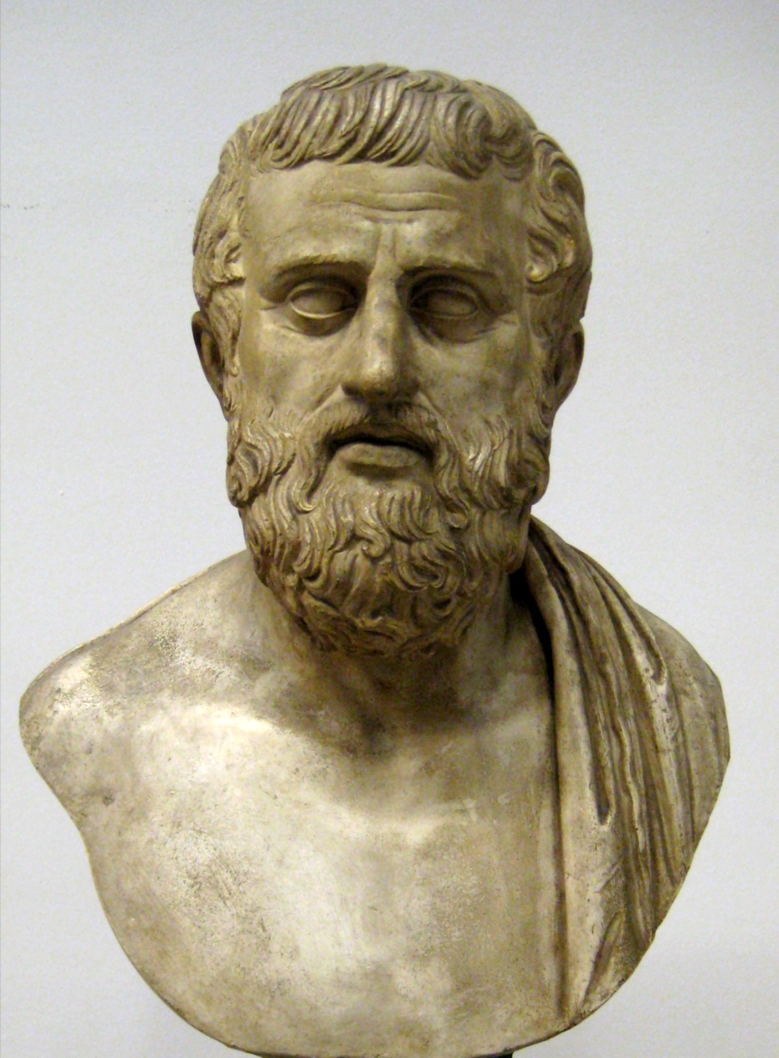
That is the aspect of the character that fascinated me, both back in high school when first encountered this play, but especially today. That’s because it occurs to me that as I perform the narrator functions of Alfieri, I will use some of the same “muscles” I use when I am writing my fiction, and that is not usually the case on stage.
I of course did not write this story, and within the play, neither did Alfieri. Nevertheless much of his job is to set the scene in direct address to the audience, much like an author does for the reader. To me this requires a particular approach and interpretation of the lines that I feel my being an author can enhance to some degree.
Authors are all narrators to some degree, aren’t they? Depending on which story they are telling, they can be reliable or unreliable. They can be a character within the story, as in first person point of view, or that can be distant observers, and nearly objective. (As one finds with third-person omniscient point of view.) The author’s voice is usually kn the past tense, telling a story that already happened. (Though increasingly in modern fiction we find present-tense narratives gaining popularity.)
The job, however is always the same–to tell a story to the reader.
Usually when I play a role on stage, I am within the story. Most roles for the stage are in fact of this variety. Actor are of course presenting a story no matter who they play, but they are not usually telling it. The script as a whole is telling it, the playwright is telling it. But the characters, even the leads, are a fraction of the story. Their job is to give that fraction life.
Only half of Altieri’s lines are like this. The rest, as I said, is direct, first person story telling to the audience. I look forward to entering an antechamber of my author mind as I perform these sections of character-as-narrator. I welcome the challenge of relating directly to those in the seats, as an author must with his fiction.
I realize it is not a direct correlation, but closer than I have been for a while on stage.
Interested in how it all works out? Consider coming to see it yourself, in your are local to Hagerstown, Maryland. Check out the Potomac Playmakers for details as we get closer to a mid-November set off performances!
(At least for that half of his stage time.)
Stories Filtered Through Characters
A few days ago, I auditioned for a community theatre production, as I often do. I have also been to this venue a few times before.
Like many auditions, in consisted of what we call “cold reading from the script. In other words, we read the script, with as much acting as we could, with others to create scenes from the play, as opposed to having memorized speeches to deliver from elsewhere.
One thing about this audition that for me was atypical; I tried out for only one role.
I never do this, or if I have before, not above once. Yet in the case of this story, this script, so connected am I to one spec icic voice, one particular angle on the story, that I expressed the desire to be considered for that role and that role only. The story, the essence of the piece as a whole does not speak to me from the other characters.
I think this happens with stories sometimes, both as the author and as the reader.
We bring certain things to the table when we approach a story. Personal history, preferences, time of year, time of day even. These particulars allow for a specific reflection off of the stories we consume. Most often, I dare say, this reflection takes in the entire story as an experience. But everyone now and then, as is the case with the production I tried out for, what we bring into the table is distilled best through one particular point of view.

A memorable, resonant character that does and says things that move us can, in my opinion, make up for other lackluster aspects of work of fiction. It’s probably best when we can delve into all of the aspects, but let us not dismiss the odd possibility that any given day it is not so much the story, but the story as filtered through a particular person that calls to us.
It may not be the most complete presentation of the story. In some cases it may not even be the most objective, (if objective point of view in fiction is possible.) But it might just be the most engaging, interesting, and worthiest of our time as readers, (and writers on occasion. )
As of this writing I do not yet know if I secured the role I auditioned for. It was the narrower, probably riskier way to audition. But when you find a voice that matters to you specifically to such a degree, it’s worth the extra risk.
If you’re acting. If you’re reading? Well, there no risk at all in this approach.
Love the characters you love, and consume stories accordingly.

 Ty Unglebower