Where Did You Park?
“Where did you park?”
It’s a common enough question, say when people meet a friend for lunch. It’s not usually vital information, but it’s often one of those throw away questions people use as a conversation warms up, I’ve found.
“At the Carroll Creek parking deck,” they may answer. Simple question, easy answer. Nothing weird there.
But what if you found yourself on the receiving end of the following types of questions about your parking?
“Which floor of the parking deck? Which space was it? How many spaces away from the entrance? Did you make it on the first try, or did you have to back up and try again? Did you have to stop for someone else while you were looking for the spot? What cars, if any, were on the spots on either side of you when you got out?”
For me, such questions wouldn’t be too private, exactly. None of that information would be, in most circumstances, secret. But frankly, who the hell cares? How many people would even remember all those details about parking their car?
Again, if it were me on the receiving end of that third degree, I’d probably start wondering if my companion was interested in my company, or my parking habits. I’m here now, isn’t that what matters?
Yet sometimes readers, and even writers approach parts of stories in this manner, without a second thought.
In any fiction, there are relevant, vital details, and there are decorative, mood building details. An example of the former would be where the suspected murderer was during the determined time of the murder. Assuming you’re writing a mystery, there is a good chance that revealing this information at some point in time will be vital to your story.
The latter type of details? Well, those, as I said, set a mood, or deepen the experience. The detective drinks his steaming hot coffee out of a Baltimore Orioles mug. That fact doesn’t move the plot along, but it gives you a simple visual in the detective and the scene. To some, it’s still extraneous. For me, those details, in moderation, are still desirable.
But consider this passage:
“I’d seen O’Connor like this before. I’d come at a bad time. He’d gone without two things that morning; caffeine intake and his beloved mug. (The only thing he’d drink coffee from.) Over his swearing and the thumping of boxes and scattering of papers in the already messy office, I told him I’d be downstairs when he was ready. I stepped out of the office.
In the lobby I met up with Mrs. Baker, who had the files I’d asked for. We perused them together, and I noted, not without surprise, that credit card receipts had shown no activity on the suspect’s card in over a month.
“How can that be?” I asked.
“Maybe it isn’t,” I heard behind me. I turned to find O’Connor smiling, steaming coffee in his recovered mug.”
You can probably deduce which of these details are plot-oriented, and which are mood decoration or scene-setting.
If, however, you’re someone obsessed with “parking details” you’d want to know where the coffee mug had been hiding.
“You set up the fact that it was missing. You told us he was looking for it, and then you left him there. Next time we see him, BAM! he’s found his mug, and all is right with the world again. Where was it?”
To such questions, I respond with, who gives a damn where the mug was hiding? We know O’Connor loves coffee, loves that Orioles mug, and keeps a sloppy office. That gives us insight into what kind of man he is, and even what sort of story we are dealing with. We get an idea of what his office probably looks like. Wanting to know where and how he found the mug is parallel to asking your friend every last detail about how and where they parked.
They parked their car. O’Connor found his mug. Moving on.
Avoid telling readers where everybody parked. Yes, there are a few people who want to know such things at every turn, and they will have their defenses for such desires. But don’t bog your writing down with such things. Find a legal spot, park safely, and go enjoy your lunch with your friend.
Nanowrimo 2015.
November is approaching, and though you didn’t ask me, I’m sharing that I won’t be doing Nanowrimo this year, for a few reasons.
I’ve done it and “won” several times, including the last three years in a row. Each of those three times, it took on a different form than the standard.
In 2012 after much consideration, I used Nano to begin what at that time was to be Novel 2. That was not the original intention, but I had the outline, I hadn’t started, and November was approaching. I had hoped it would give the project a jump start. I reached the word count, but ultimately I shelved Novel 2.
The following year, I undertook what I consider my greatest Nano challenge of them all so far. I was determined to not just get to the word count, but to finish the entire story in a month as well. I’d never done that before. It was the most exciting, high-pressure Nano since my first ever attempt at same. And I did it! My first ever mystery novel was born from that experience; a novel I intend to one day edit and make available. (Stay tuned on that.)
Then last year I openly decided to be a Nano Rebel, as they call it. I opted for 50,000 words spread over a short story collection with a common theme. And again, I’m proud to say, I did it. Reached the word count and got I think 11 stories out of it. All but one I found worthy of keeping, and editing. That collection may also someday be available in ebook form, again stay tuned.
Now here we are this year and…I’m not doing it.
One reason is that I need a break from it, i think. I’ll miss certain aspects of it, but there are some other things I want to be working on next month, so it’s for the best.
Secondly, I wonder if there is anywhere left for me to go with Nano. I have proven I can write 50,000 words in thirty days. I have proven I can write an entire plot with those 50,000 words in 30 days. (Though I don’t think I want to put myself through that again!) And I have proven that I can write a short story collection of 50,000 words in 30 days. There isn’t much left to “prove,” to myself, is there?
Not that proof is the be all and end all of such things. Fun and creativity is, and I have certainly achieved that as well over the years. But unless I personally upped the word limit several thousand words, to see if I could still finish in 30 days, I don’t know if there are many ways to make it different, and still remain in fiction. (As in, not moving into poetry or screenwriting or something, which to me are totally different animals anyway.)
The one idea I thought could be different enough would be to repeat the Rebel short story idea, only without having a common theme between the stories. The common theme does allow a sort of beacon by which thoughts can be focused, and time shaved off. I gave the briefest of considerations to doing this, but as I said, I need a break and have other things I want to do with those 30 days.
So maybe I have a structure for next year, or some other future Nano, I don’t know. It’s not that different from what I have already done. Short stories equaling 50,000 words in a month; I’ve done it.
I start to wonder if I’ve reached the ultimate end of the road for Nanowrimo. It has been an invaluable tool to me over the years, forever changing and improving the way I approach new fiction projects. I will always have that from it. And assuming I live a long, healthy life, (which of course I hope to!) there are many Novembers remaining. Too many to say anything for certain. Yet to be honest, it may be time to put Nanowrimo behind me, and find different types of challenges.
Maybe not…but certainly for this year.
Columbus (Story) Day.
Columbus Day. There is a small but growing movement to discontinue the holiday, given what history suggests was a rather terrible person at the center of the days celebrations. I agree with the sentiment. I’m not here to repeat what others have said on the matter; it’s been done better than I could do today anyway. If you want to know more about this position, there are hundreds of sources online telling of the real Columbus. Here’s one by Eric Kasum. Bill Bigelow authored this piece. Those are, as far as I can tell, some of the most read of the last few years, but as I said, there is no shortage of information on this.
Yet the entire “abolish Columbus Day” movement would not ever be in issue, if the day didn’t exist in the first place. Why does it exist? In short, in the early 20th Century the Knights of Columbus organization sold Congress and FDR on a story of Columbus, and this the day was born, which in turn birthed more myths.
“In 1492, Columbus sailed the ocean blue,” kids are still taught today. He discovered America, thinking he was in India, to trade spices. In the process, he proved the world was not flat, and that’s why we have North America today. (Though often, he is credited with simply “discovering America.”) He made friends with the natives and eventually this benefited everyone in the world, which became a lot bigger (or smaller depending on your view.)
As the two linked articles, countless others, and a simple understanding of history tell you, about 90% of the above paragraph is nothing more than a story. Hell, the man’s name wasn’t even “Christopher Columbus.” A story that endured in part for centuries, and almost in it’s entirety in the mainstream of the United States for decades so far, only in recent years starting to unravel. (Though if it is ever totally rejected, I predict it will take several more decades at least.)
If you set aside the bold self-interest of the Knights of Columbus, the selective memory of them as they lobbied, and the collective willingness on the part of educators and adults to submit this version of events to school children for generations as fact, it’s quite a story.
Story.
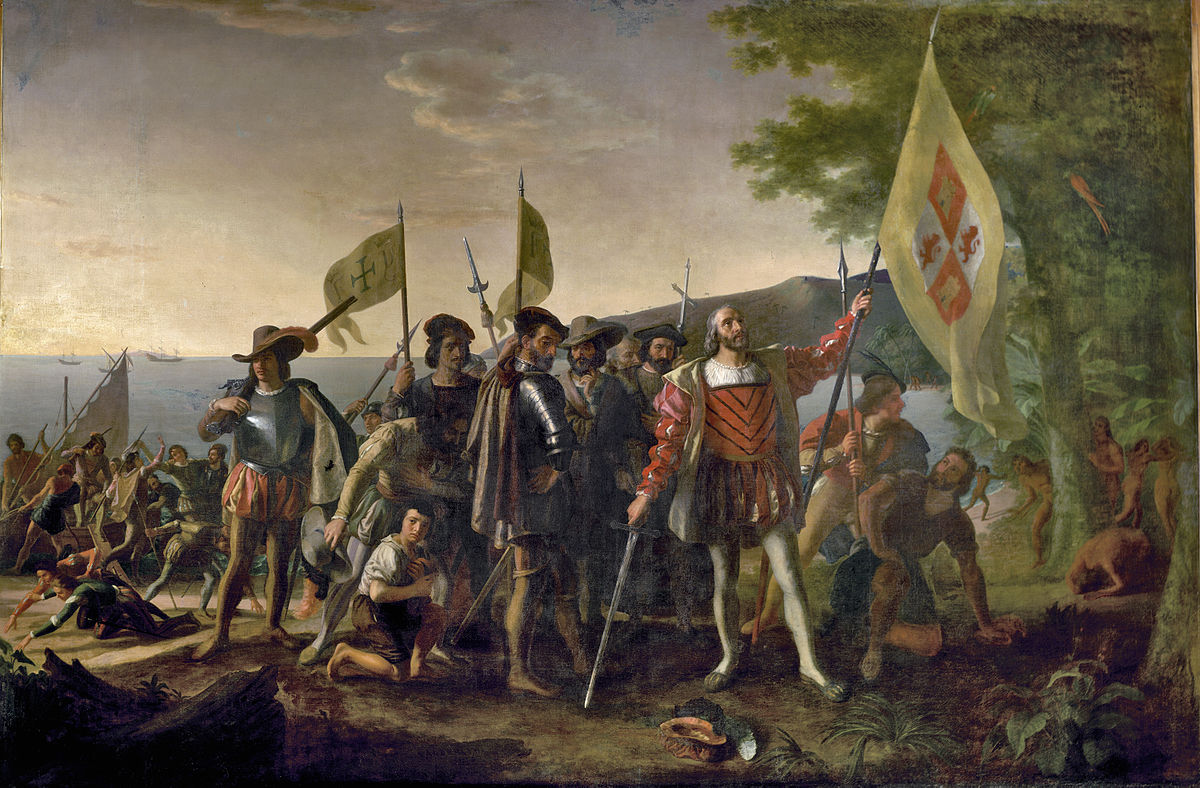
“And, I can juggle. Make sure they know I’m a juggler, too.”
Much like the well-accepted but historically rejected version of America’s “First Thanksgiving,” the power of story is in evidence here. Yes, a touch of lobbying, official government banking, and a sprinkling of bias and certain racism helped solidify the the historio-mythical meta loaf in both cases, and countless others, but story is at the heart of it, as it is at the heart of so many other things, whether we realize it or not. Story, if we are not careful, becomes history-indeed it has been known to replace it.
This is evidence of neither the intrinsic good nor the intrinsic evil of story creation and telling. Rather it is indicative of of the power of story, especially once embraced by some aspect of the public. True, not all beloved stories alter our understanding of our own history; most are in fact not designed to, or presented with that intention, as the story of Columbus has been. But any story, and hence any story teller with an audience has potentially great power. Those of us that make it both our living and our leisure to create, share, and sell stories would be well advised to remember this awesome responsibility, even as we seek to succeed as authors.
Wishful Thinking: Readers
There’s nothing wrong with wishful thinking, so long as you don’t rely on it. Sometimes the object of our wishful thinking is not a bad idea in and of itself, but is not practical to initiate or expect at any given time.
I engage in wishful thinking, and so do you, whether you admit to it or not. In this case, I have some wishful thinking about readers.
Mainly, I think it would be nice if more readers dug more deeply into possibilities when looking for something new to read. Beyond genre, and even beyond subgenre. If more of them were at least a few times ultra picky, ultra specific in what they were looking for, I think more unknowns, such as myself would get discovered.
There are millions of self-published books, and any given author is going to get lost in the crowd if they don’t have a lot of luck and some promotion savvy. My book will no more magically appear in front of the eyes of a reader who might like it than will a pot of gold. I get that, and I am doing my damnedest to figure all that out so more people will buy my books. (With limited success so far.) But that is in the non-wishful think world. In wishful thinking, people wouldn’t settle just for what is easily right in front of them when they search two or three keywords, or scroll through one genre, or one best seller list. They’d decide they wanted to take a chance on any book that contains their mega-specific set of interests, and seek out same by conducting a search that takes more than a few minutes. By doing so, they may discover they are a niche that an unknown author is writing for already.
I have done this as a reader. Searching for, “Papal, Vatican, suspense, mystery, political” I have found more than one book, and in one case, have read more by the author of same because I liked what I read so much. Books that combine those subjects and tones and genre aren’t exactly flooding the market. But because I decided to put in the extra effort to seek out books by authors (traditional or self-published) that contained so many of my particular tastes, I found someone I might not have otherwise found.
It is the authors who conceive the books, write the books, edit the books, or find the agents, make the revisions, do the promotions, engage in the marketing, make the connections. Use keywords, write synopsis, go to conventions and conferences and so on, all in an effort to stand out at the right time in the right place among the endless books out there. We do it, albeit reluctantly at times, because what choice do we have? All so one day someone, or thousands of someones will notice the book and choose to read it.
The reader is the one who hears of the books, gets it and reads it.
I’m not angry about it, but every once in a while, if the majority of readers put in as much effort as some do in finding something unique to read, we may just have more of both happy readers and happy authors.
Collaborative Learning Forced on Introverts? How About Not?
The subject matter in this article in The Atlantic annoys me. If you have read even a little of this blog, and certainly if you have known me for more than a few hours, you’ll know why once you read it. I don’t want to rehash an entire article, so go ahead and read it first before reading this response. It’s about introverts being left increasingly behind by design of our educational institutions in this country.
Read it? All right. Now some of my thoughts on the matter.
It stinks.
Not exactly my most probing commentary, I realize. Yet it absolute covers my feelings on it. Ridiculous, tone-deaf, unfair, short-sighted and typical would also have worked to describe my assessment in brief terms. (I guess they just did, in fact.)
I imagine that these types of collaborative work spaces are effective for a fair number of people. But the assumption that it is the apex of “human evolution” or whatever hoo-hah that one paragraph said, (to me it’s not even worth the time it would take to research the exact quotation) is as arrogant as it is misguided.
To me it’s like spending all day in school ridding kids of local accents, so we all sound like we come from New England, because hey, the Revolution started there. Or forcing left-handed children to write with the “correct” hand. (Our society used to do this.) There is a difference between access to, or brief exposure to a perception and process different from your own, and being shoehorned into an uncomfortable alternative while a captive audience in a school, because “human evolution.”
I’m introverted. Do I strike you as unable to advocate for myself and my beliefs so far?
I for the most part hate “group work” when the result is mandatory. In my experience, the kid who is loudest, or thinks himself the smartest or at least the funniest dominates the group, and nobody stands a chance to contribute their own ideas to the mix, unless the yell louder, more often, or enter into an equally unproductive confrontation with the boisterous types that also tend to take charge of such “groups.” That is “leadership” in more and more places in America these days, and it’s becoming an epidemic. I haven’t been to school in years, and it was already somewhat trendy when i did go, and I hated it. I lament for poor kids like myself who have to deal with its near-ubiquity today.
And bless the career of the author of this article for including this sentence, (one that is worth quoting exactly)-
“Meanwhile, some advocates for ‘active learning classrooms’ write about ‘breaking students and faculty out of their comfort zones’ like it’s a good thing…”
That’s at least partially in tune with my notion that forcing people out of their comfort zones for its own sake is not noble. When exactly are the more extroverted people in classrooms supposed to be made uncomfortable by sitting down and keeping their mouth shut and listening to somebody else talk for an extended period of time? By considering the possibility that someone quiet might have the best idea in the group even if they do not shout, and that everybody should calm down and listen to it for a moment? Have half of the kids in our class room step into that zone for a semester, then call me about comfort.
If I sound frustrated and annoyed by the concept making classrooms and universities more extroverted, as well as the attitude behind it, I am. If i sound like I am declaring extroverted efforts out of line for everyone, and collaborative learning to be worthless, I am not. I’m not against giving extroverted students, or those who thrive on energetic interaction in school being placed in situations that suit them. But let’s stop acting like those situations are some sort of ideal to which we must aspire, dragging kids along who obviously don’t want such. Let’s stop criminalizing the subdued and the quiet. Make sure they do not avoid their responsibilities in school, naturally, but make sure those responsibilities are in line with who and what they are.

 Ty Unglebower