“Farewell” to My Characters?
I’ve been in many stage plays over the years. Some were good, some were bad. Yet in most cases, there’s an image I associate with the ending of such productions.
In most cases, on my level of theater, the actors help to tear down the set and clean up the venue after the last performance of a show. Then, about nine times out of ten there is cast party to celebrate the show. Unfortunately this is usually on a Sunday evening, and for most that is just not a optimum party time. Full attendance at this cast party is rare, because people need to get home and get ready for whatever their Monday is. For those that do come, there is always the hurried, awkward farewell to everyone when someone leaves. Eight weeks together on most night with such people getting ready to do a show to the best of your ability. (If you’re with a cast that gives a damn, that is.) Ups, downs, success, failures, meals, arguments, confusion, chaos and all such things shared in usually close quarters. Then, a burger and a piece of cake at someone’s house, and bingo, it’s all over. You’ll see most of those people again, but it will never be the exact same chemistry as it was for the production you just closed.
There’s a bit of a hole there, as you might imagine.
But the “last goodbye” I bid when a show closes is not to the cast or crew. It’s to the character I played. It’s not a complex thing. It almost always happens on my way home after the cast party. My drive home from the cast party is what I consider the last “official” action of a production I’m in, since when I left home that morning, the show was still on. And during this drive I often have an image in my head of the character I played in the show standing on the stage alone, and the vanishing, or fading away back into my imagination; their job complete. That’s when a production ends for me.
Sometimes this fading is sad. Sometimes it’s closer to neutral. And yes, a few times, I’ve been relieved when the character waves or nods goodbye to me and is on his way. Yet whatever I felt about the character or the show, that moment represents a “period” at the end of the sentence. I may play that character again in the future, (though this has not happen in my career yet) but it will not be the same. I will have changed, the cast mates will have changed and so on. A different version of the character will bid me goodbye after the show is over. That’s just the way it is.
Now, as the release of my novel, Flowers of Dionysus approaches, I have been wondering what saying goodbye to my characters will be like in this context, for surely it will not be the same as it is when I part with a character I played on stage.
It’s different for a novel than with short stories. At least so far it has been. In short stories, I can appreciate and like the characters I create, no doubt. But for me at least, my short fiction tends to be about the scenario and how characters react to it. We learn what we need to learn, but a short story is a passing glance from a slow moving or temporarily stopped train. The novel is being on that train. And I have been on this train fro several years now.
And of course maybe future novels will not feel like this to me upon their completion. I probably cannot take this long from now on to finish a novel as I did for this one. Still, there is a greater potential investment in characters in novels one writes than in short fiction.
But back to the departure of characters.
First off, I feel that right now in regards to the novel, I’m about to get in the car and drive home from the cast party. Though all edits are done, and the formatting for e-publishing is as good as complete and a cover is selected and the date is known, I still consider myself officially “writing” the novel in a way. The characters are in a sense still under my control, despite the fact that there will be no further major editing of the manuscript. (Nor minor edits, if I can help it.) Yet, until I push the button that makes the novel available for purchase, the characters feel like they are in my sphere or influence in a spiritual, if not literal sense.
The more I think of it, the more it may be the opposite of what I experience at the end of a play. In that case, as I said, everything is over, and the character goes away in a sense. But with a novel, one could argue that the characters are just about to exist fully for the first time! For when my novel is published, that will be that. I will remain the creator, but from then on out, the characters will belong to the reader. Whether 10 or 10,000 people eventually read my novel, those I have written into the novel, Matt, Centauri, Tanya and so on will spread through the imaginations of my readers like food coloring in a cup of warm water; they will swirl and sink and float and dance in endless unpredictable patterns within the minds and hearts of those that read about them. Their pasts, futures, clothing, the way they move about will differ depending on who is envisioning them. As an author I have described a good portion of what they are about, but I can never cover every moment and every nuance. My readers will fill that in.
So, when that happens, my job as author and creator is concluded. But unlike when my job as an actor in a play has concluded, the characters I created will only just begin their journeys: their many journeys.
I suppose in a sense the characters in the novel are packing their metaphorical bags these days, as they prepare to exist outside the imagination and drafts and files and muses of their author. They bustle about like a group on the final day the hostel is open, gathering stuff, looking for their hairbrush, making calls and getting ready to go. And I run the hostel.
Each of the characters are probably too busy to give me the full fledged, dramatic exit that the characters I play on stage have time to give me on my ride home from the cast party. The novel characters have a lot to prepare for after all…splitting into so many imagined versions of themselves and all, waiting to take up residence in the hearts and minds of readers. They may cast me a glance, or a smile or a wave in a quick moment though. Besides, like I said, they are not vanishing. A novel is forever in a way a play cannot be.
But it’s cool. Both they know and I know I am the author. There’s a mutual respect and gratitude there, even as they go out into the world. I’m content with that, I think. Any author should be, I dare say.
Memorial Day (Repost)
On this solemn day, i wanted to simply repost what I said last Memorial Day here on the blog. I haven’t seen quite as much “Barbecue Shaming” to coin a phrase this year as I have in years past. Nevertheless, I think it’s important to keep in mind the relative innocence of hosting cookouts and barbecues on a day like this. So, enjoy this post from last year. –Ty
*
“I find myself each year resenting the reminders that are all over the internet that Memorial Day is “not National Barbecue Day”.
It’s condescending. I don’t need reminded of what today is.
I’m opposed to the mutually exclusive tone of those reminders. Are we incapable of having a barbecue and respecting the fallen at the same time? A day off is a rare thing for some people, so why can’t they enjoy it? Are we expected to fast and sit in a dark room all day because it is Memorial Day? Or on that day do we opt to partake in the pleasures and rights for which so many died in service to this country? Maybe people barbecue on this day off in tribute to those who will never again go to a barbecue and enjoy life. And even if that isn’t their direct motivation for firing up the grill on Memorial Day, I choose to believe most of the fallen would not be offended that someone opted to eat outside today and maybe even enjoy themselves.
Having a barbecue on Memorial Day is not dancing on somebody’s grave, yet that’s the impression some of the memes give off.
Speaking of graves, I’m offended at how often the “Just in case you forgot…” messages are accompanied by some picture, usually of a woman, draped over a coffin or a tombstone, or laying on top of a grave with a blanket. I can’t say nobody has ever done this, as people handle grief in their own way. But to begin with, how verifiable are most of those images? Do we know it really is somebody’s widow and that there’s anybody in that coffin? Furthermore does it matter? If it’s not authentic, it’s pretty screwed up to stage something like that in order to make some quick point. And it’s even worse if the photos are authentic. Who the hell is taking that picture, and making it available to the world? Who with a camera says, “I want to make sure I get a shot of this.”
But far worse than taking the picture is using it. Posting pictures of wailing widows and devastated children, authentic or not, and captioning them with a mini-sermon about having a barbecue is more offensive to me, and certainly more exploitative of the day than any picnic can be. Are we honoring the dead with those memes, or are we seeking acknowledgment of our own “honor” by sensationalizing on the backs of such images?
I do not need to be shocked into understanding Memorial Day. Nobody needs to, in fact. Those who are going to honor Memorial Day are going to even in the midst of a barbecue, and those who are not will not be convinced to change their minds because of some meme.
People are free to honor the fallen and respect this day in whatever way they choose. I myself choose the subtle, introspective route. And while I take that route I may be at a fun event or have a burger, it’s true. You or others may opt to be more quiet and somber all day long. It’s all acceptable. But let’s cool it with the judging of others with these framed guilt trips that we can fire off at the push of a button to our social media connections.
As a writer, I’m well aware of some of the things for which many people have died in service to the Constitution. Every word I write is a testament to that understanding, even if it isn’t on the forefront of my mind at any given moment. It’s a sacred right, to be allowed such self-expression as I partake in each day; it is a right that would not exist if not for the sacrifice of hundreds of thousands of lives over the years. I know it without the memes. I knew it before memes existed.
I also know of loss, as my father died when I was seven. He wasn’t in the service, but beyond a certain point, died is died, and I’m all too aware each day of what that can do to a family. Your annual retweet on the last Monday in May won’t reinforce that, believe me. It’s always there.
So, here’s to Memorial Day. Enjoy it with prayer or with beer and burgers. Or of course both at the same time if you like. Both are part of living in a free nation. Part of being alive in a free nation. And we, and the nation are alive because a lot of people are dead today.
See? I do know.”
(Originally appeared here.)
One Month Until Launch
To announce the one-month countdown to the launch of my novel, Flowers of Dionysus on June 21st, I’d like to share with you the cover I’ll be using for the e-book version.
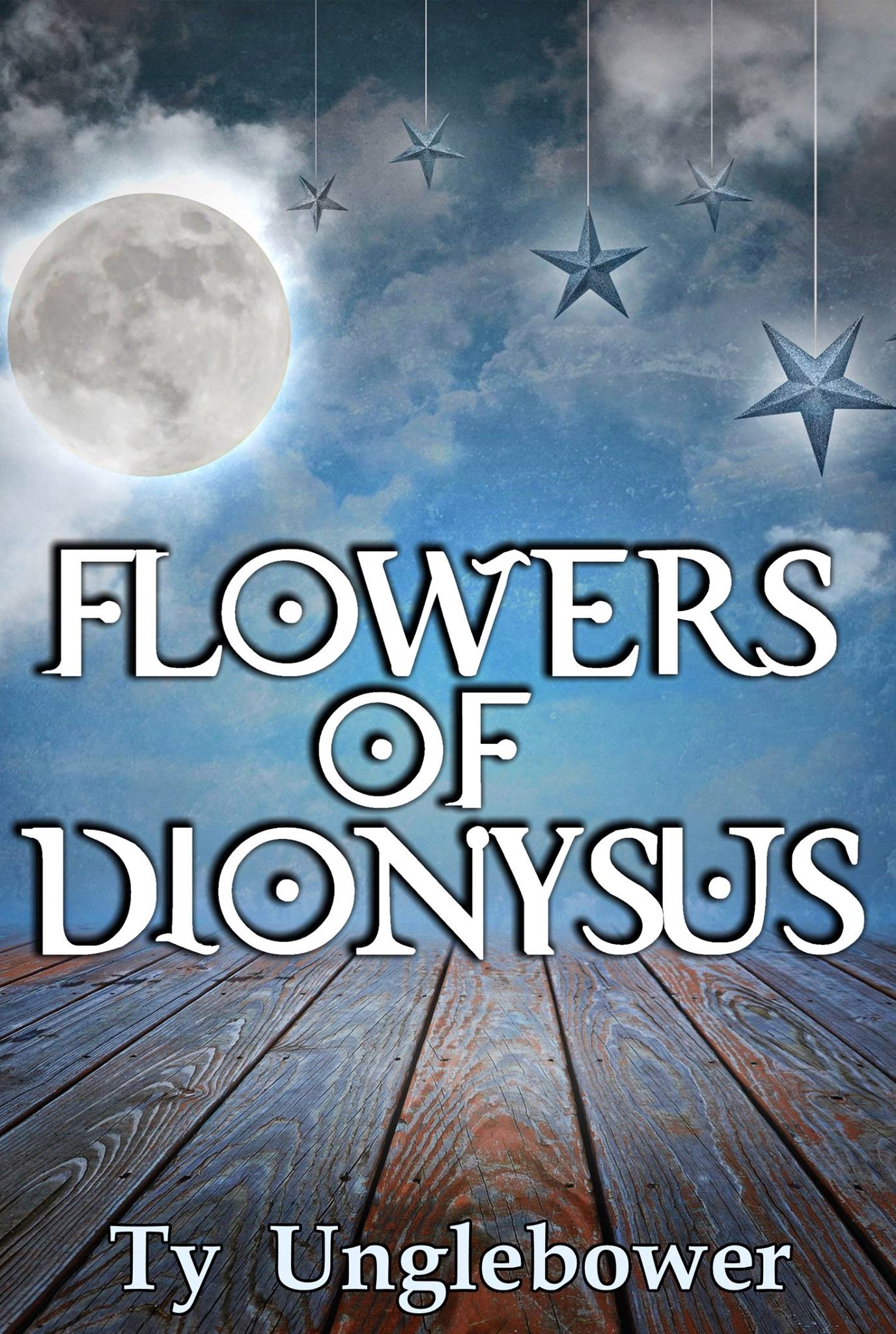
This charming cover was designed and produced by my friend and fellow author/self publisher, J. Lea Lopez. She also helped out with line editing for the final draft, as well as the cover of my short story collection. Thank You For Ten. Much thanks goes out to her. Do visit her pages, and read her stuff, and so on.
I have a few small techie things to take care with the novel, but for the most part, this is the last big step before the launch, showing you this cover. With this reveal, it all becomes rather “official” for lack of a better term. I’ve talked about the writing, editing, theme, characters and overall journey I’ve taken with this novel over the years. I’ll probably post some interesting lines from it on Twitter over the next four weeks, but for the most part there isn’t much else to share leading up to things. The die is cast now, and in some ways it’s weird, and in other ways a relief.
Theatre to me, even when it has not been of great quality has almost always had a certain magic to it. Just read my other blog to learn more about that. I wrote this story, about passionate, sometimes silly people doing their best to create theatre because I wanted to explore and share that magic. I wanted those who have been in theatre to shake their head in recognition, and those who never have to experience some element of what theatre can open up in our worlds and in our hearts, especially when nobody is paid to do it. This novel, which is in many ways a fantasy nonetheless is deeply grounded in a true sense deep within me, or what the performing arts, and art in general can do for people and for the world. The supernatural elements may be somewhat more visible within my novel than in real life, but I assure you such things do in fact exist, in some form or another, within the actual world of the theatre. I hope if you are reading this post, you will take part in what I hope is a fun journey into such a world but buying and reading Flowers of Dionysus.
How to Look Like a Writer
I don’t “look” like a writer much of the time, I dare say. I try to act and think like one, of course, but I don’t appear to be one.
Okay, yes. Yes. I know that there isn’t one look for all writers. I know that any attempt to define one would require perpetuating some goofy stereotype or the other. Writers come in all shapes, sizes, styles, and so on, and I know. Yet unlike a cultural, racial or religious stereotype, I think career stereotypes can sometimes, if we let them, have an element of fun attached to them, if we don’t take ourselves too seriously.
Also, unlike the immoral stereotypes I mentioned above, certain careers can’t deny recurring tendencies that are quite common, all be they not universal. If you don’t believe me, go to Twitter and search for #amwriting with the phrase “my cat” along with it. Using “coffee” will provide a similar number of results.
A legion of writers have cats, and drink large quantities of coffee. Often enough that those things are sort of stereotypical “writer stuff.” I don’t think it’s horrific to have fun with that a bit. Especially since neither stereotype applies to me; I am allergic to cats and I do not like coffee. (I know.)
But back to “looking” like a writer.
We’ve established that there’s no dead give away look for a writer in every case. Yet sometimes I wonder if I would, “feel” writerish more often if I catered once in a while to some of the innocent stereotypical writer looks. Obviously I’m not going to walk around being inauthentic to myself in some painful, offensive way, so don’t worry about that. Yet maybe I could experiment a bit with this.
I could walk around with my ancient laptop in public more often. I’ve mentioned before that I don’t do a lot of coffee shop writing. Once in a while I write in the library, though these days it’s not much quieter in there than in an average cafe it seems. But I could do it more often for the sake of projecting “writer” into the community ether. A lot of people have laptops however, so that alone wouldn’t convey “writer” per se. It’s a start, though.
Once upon a time, going a few days without shaving may have helped this cause, but anymore it seems that not shaving is the default position for a lot of dudes these days. Though I think the recent Beard Renaissance is waning, it’s still strong enough to not convey much of anything unique. Besides, I’m not talking beard, I’m talking some whiskers for a few days, which in the prevalent beardism of our day wouldn’t even be noticed. But for nostalgia, I can give it a try.
On the subject of hair, I could go a day or two without brushing mine. If not “writer” that often seems to convey an air of “creative type.” We’ll call that a maybe.
I do carry an idea notebook with me most of the time in public, but it’s pocket sized and not usually visible unless I’m actually using it. One plus here is that when I am using it, it’s so old and beat up it probably helps the image of “artsy dude” if people actually saw it. Maybe I need a bigger, fancier one to carry around outside of my pocket all of the time, one with a bunch of loose leaf paper stuffed into it here and there, because ideas.
No cigarette smoking for me, that’s a deal breaker. Depending on the environment I might MIGHT might keep a cold, empty pipe in my mouth for effect. I might.
Wearing black, there’s one! I could see myself walking around in mostly black for any number of reasons. (Not all of them romantic; it’s easier to hide a food stain on something black.) I’d avoid looking morbid, but I see promise in the wearing black deal.
What about corduroy? Does a corduroy jacket say “writer” or does it say “professor?” I’ll look further into that one. A jacket in general though probably helps. Black jacket of course over top a standard button down shirt? Yeah. (I just realized how much easier it might be to look like a stereotypical writer in the cooler months of the year…)
But not a beret. The beret is indeed probably one of the ultimate writer stereotypes. This is left over from the Beat era I would assume, but it’s more cartoonish than anything else. I mean, how many people of any type walk around in a beret these days? (Though this loser I once knew that wanted people to think he was a profound writer would allegedly spend hours drinking coffee and wearing a beret at the local Denny’s, jotting down ideas on paper the whole time. That image alone is enough to sway me from trying this.)
Pencil behind the ear? They don’t stay behind my ear very well, but I’m willing to throw that image into the mix. Pencil behind the ear it is. But I can’t chew on the pencil. That drives me crazy when other people do that for some reason.
So let’s review our “writer” look: (Probably) long pants or jeans. Button down shirt with a (possibly) corduroy jacket over top, all some shade of black. Sleeping in all of the above the night before would probably enhance the effect.
Slightly unkempt hair, and a few-days beard, (which, though probably not as effective as once upon a time, is still useful.) Unchewed pencil behind the ear, laptop and/or rugged notebook under one arm, and once in a while a pipe in the mouth. Maybe.
Then to the coffee shop I’d go. I’d order tea, and I’m told that tea is not as “writer-like” as coffee, but oh well. I can’t win them all. Sit there for a while and type and/or scribble. Looking off into space every once in a while as I try to think of something wouldn’t hurt either.
Sounds like a winner to me.
Not as much as spending time writing a blog post about looking like a writer, though. That’s the true giveaway of a writer, I guess.
Did I leave anything out? How else can I pursue looking like the “typical” writer for a day or two?
My Writing Process
I don’t have one.
All right, that was a cheap cold opening, and also not 100% accurate. It’s not a lie, either. Because in most cases I don’t have a consistent process that I follow when I write. I don’t start at exactly the same time each day, I don’t have certain music on, or have to have a certain type of tea with me. In fact I almost never consume anything while I write. But even that isn’t part of my process per se; I was trained early not to eat or drink near a computer, and for the most part that has stuck with me.
Shock of all shocks, I don’t even write every day. Most days, but not every day. I’m supposed to write something, every day, aren’t I? At least according to the writing process scriptures on which many writing advice sermons are based. Chapters in that book include “Butt In Chair” and “No Twitter!”
Don’t misunderstand me, please. I’m not saying that those with a highly regimented writing process don’t know how to write. Writing is hard, my friends, and if waking up every morning at 6:04AM and sitting down to write for a non-negotiable hour while drinking tea helps you to get any writing done, than I’m all for that for you. In your life, that is the secret to writing. Ritual helps more writers than it deters, I dare say.
For me, however, I have a bit of a problem. I don’t have any name for this problem, so the best i can do is describe it thus; I have a bit of ritual addiction. I mean no disrespect to anyone who suffers legitimate addiction, but I have to co-op that word to get my point across. If I allow myself to remain tied to a routine, I run the risk of having to repeat that routine every time I undergo a certain activity. When that happens, the ritual becomes the focus instead of the task itself. I will not say I am OCD, because that is a true condition, and with huge amounts of concentration and effort, I can alter most such rituals I get stuck in. But before I do so, it can feel a bit like OCD is described. That’s often how I am when I go to bed…if I don’t do thus and so, I’ll notice it, and find it more difficult to fall asleep. (Not something I’ve ever been good at anyway.) I’m working on it.
That’s why, with some exceptions here and there, I haven’t allowed myself to create and unrelenting writing routine. I fear that eventually I could only write well if all the little touchstones and idiosyncrasies were met before I started. Like I mentioned earlier, writing is hard, and the last thing I need is to tie a millstone around my neck while I’m trying to do it.
Maybe this happens to you. Maybe you felt compelled to establish a routine in proverbial stone in order to be a true writer, or to get anything done. There are certainly more voices in favor of a locked-in writing routine than those who don’t insist on it. I won’t say I’m a voice crying out in the wilderness about it, but I think I am a minority. But if you think you might be in this minority with me, than I hereby give you permission to ease up on your writing process, or routine, or ritual or whatever. If you are feeling more like you’re at gun point by following your routine than you feel inspired to write, routine is not for you. I may not know what exactly you have to do in order to bring about more writing in your life, but I can tell you that blind ritual isn’t it.
I’ve tried it here and there. It had mixed results. Writing at the same time each day, or putting on a certain piece of clothing. It works for a while, then becomes more about the idea than the work, and I annoy myself and the writing suffers a bit. Which is the exact opposite of what a writing process should accomplish. So if that’s you, forget the ritual already.
You have to get the work done of course. Nothing will write itself. But it’s okay if some day you wake up wanting to write first thing, and other days you don’t feel like writing anything until after your breakfast, or after a walk. No, you can’t always wait until you “feel like” writing, but discipline comes in many forms. I myself set my own writing deadlines for things I’m not writing for other people. I have a list of writing accomplishments for each day I cross off as I complete them. Sometimes I journal or free-write. I give myself permission to only write a paragraph any given day. Each of these things shows that I’m still committed to writing, but that the writing take precedent over the process/ritual.
So, it doesn’t have to be every day at the same time, unless that helps you. But my general advise is to write often, set deadlines, respect them, and go easy on yourself if you slip and slide around for a few days. Water is the life sustaining substance for most lifeforms on the earth, yet it can destroy buildings and drown us if encountered the wrong way. Writing routines are like that. Let them refresh you instead, or carry you along on a wave, (with some work and concentration.) Embrace trends and broad guidelines instead of rigid ritual, and if you’re like me, you’ll eventually get to where you need to be.
Do you have a writing process, or routine, or ritual? How important is following it in order to write?

 Ty Unglebower