Don’t Bore Yourself As A Writer
The frequent conundrum for the writer is whether to write “to the market” or to be true totally to one’s own vision no matter what and write accordingly.
Often when I open a discussion in such a way, I proceed to explain how it is somewhere in the proverbial middle.
Not this time. And while I eschew extremes, in this case I advise leaning towards your own vision, even if they oppose conventions and rules.
Actually, I amend this. I don’t suggest breaking rules for the sake of breaking them. What I suggest, what I absolutely endorse is not boring yourself.
It is possible, believe me.
If you decide to chase the market, and write what is the current trend ignore entice an agent or publishing firm, you’re already making several mistakes. Trends change, and by the time you are done, the trend you chased could be over.
Such approaches also keep one from standing out as a voice, even if somehow one does manage to catch that gust of wind into fam and profit.
Yet the biggest mistake with writing to catch a trend would be boring yourself as a writer.
You have to find what you are writing interesting, exciting, fun.
Don’t get me wrong; by the time you are done editing and revising, you will feel someone sick of what you love. Like having your favorite meal every day, it will begin to lose its appeal.
Yet in most cases, take a break from that meal, and you will eventually remember why you love it.
That is not boredom. That is numbness. Every writer faces a bit of numbness even when they believe in their material.
Just shake it off, like you do a sleeping leg, and the blood will return.
But if there is nothing therein the first place to get back to? Might as well push a rock up a hill all day and achieve the same tedium.
Which is why I am not coming down in the exact middle of this quandary. If in your heart of heart you love writing the most predictable, formulaic stories, then you must write those. Nobody can give you any guarantees about marketability, in a conventional of self-published model. But what I can say is the process of continuing to write over and over and over is crucial…and that you will find it most sustainable if you love what you are writing.
You can tinker and repair drafts that have been written out of love and/or excitement. You can, if you decide you want to, adjust for the market as you understand it. You have a passion-informed baseline from which to jump
But if your writing is tedious, your story stale, it could be the most avant-experiment the world has ever seen, and it won’t do a thing for you. And if it does nothing for you, it’s not writing. It’s producing.
I’m one to talk, I know. I have sold, lifetime so far, 2,000 copies of my various books, give or take. But I would never have finished any of them if they bored me. I’d be better off trying to sell tires, about which I know nothing, than trying to muster up the enthusiasm to sell a story I never liked writing to begin with.
Don’t get bored. Get writing. No matter how weird, (or how common) it is.
The One That Got Away
I’ve come to the sad conclusion that the biggest acceptance of my writing that I have thus far ever received will not come to pass.
This is a hard one to swallow, I won’t pretend.
About a year ago, one of the oldest continuously published magazine on the art of writing, one to which I have been subscribed for many years, The Writer was purchased by a company mostly interested in creating television content. The current editor mentioned this in his note at the beginning of the last issue to be published, September of 2023. In that note, he called for “contributors” to offer pieces to the magazine’s next issue, as he sought to tighten the focus as well as the budget of The Writer by stepping away from national paid-freelancers.
In response to this call for content, I submitted a piece…and it was accepted.
I knew it could take a few months to show up. But as I communicated periodically with the editor, it became clear that although the magazine was not officially dead, his superiors had placed television on his main burner for the foreseeable future. He loved my piece and related to it on a personal level, but could not give an indication of when it would appear, because he had no idea when the magazine itself would return.
I have not contacted him, or he me, in the better part of a year now. My research from other sources has in fact led me to conclude that despite announced plans in 2023, the magazine is in essence, defunct.
I have a book coming out in a few months that talks more about my poor luck and difficulty in igniting my career, among other things, because of Autism. But since it is not yet out, I will use this post as a medium by which to express both how utterly disappointing, yet somehow utterly predictable this situation is.
That is to say, what was to be the first national (even if niche) byline of my life seemingly will not come to pass because the oldest magazine in the world dedicated to writing is, at the very same time, going belly up.
Such is writing, but shit. Talk about no honeymoon with success.
I am holding the piece for now, which I consider one of my better pieces, (and probably why it was accepted initially.) I am holding out for the possibility, at least until the end of this year, that the magazine could return in some form, long enough to publish my piece.
At that point, I will look for other places to submit it to. One professional editor liked it, I imagine another one might as well. I will make that decision no earlier than 2025.
I wish I had a grand lesson to share with you about this, especially fellow or potential writers who may read this. I don’t though, other than luck is a large enough factor is being a successful writer it borders on stupefying.
As my soon-to-be-released book on success and promotion talks about, some of us have more working against us than others.
Keep reading if you read, keep writing if you write.
The Love Books Festival, featuring…Me.
In a month, will cross the river out of Maryland and into nearby Lovettsville, Virginia, where I will set up my first ever author booth at my first ever book festival.
Called the Love Books Festival, it will feature about 40 local authors for signings, workshops, and lectures.
I myself will only be selling and signing books this time around. Paperback copies of my latest, The Rubble and the Shakespeare, as well as copies of The Beacons I See. The former for 10 dollars a copy, the latter for 5 dollars. (As it is so much shorter.)
As this approaches, I have spent more time, thought, and energy on marketing than writing. For example, this sign I had made:
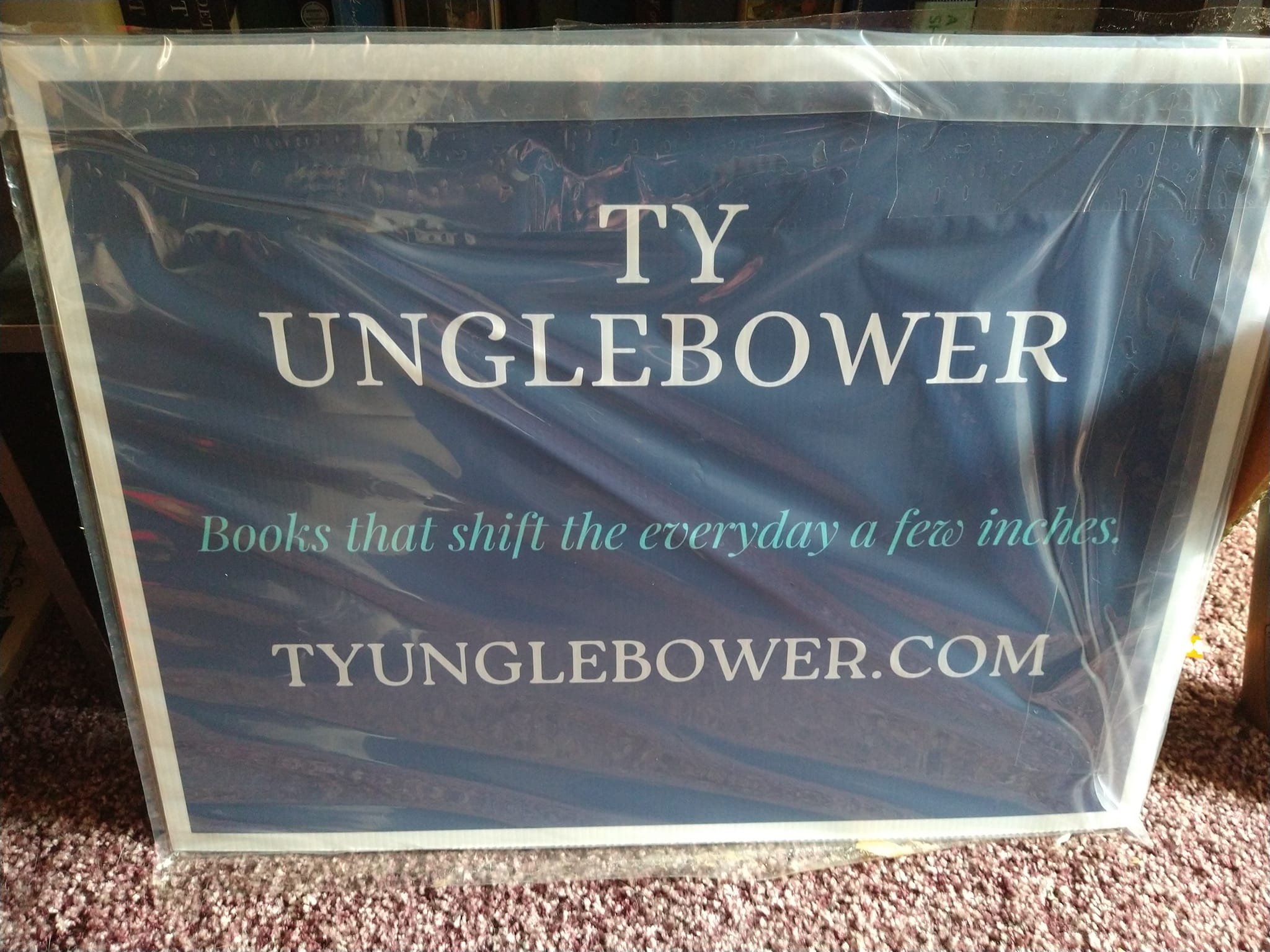
I’ve also bought a few other decorative knickknacks that convey imagery from the novels to spruce up the table. I’ll share some of those in a future post.
And though in comparison to most authors I have spend modest money, it is by far the most I have ever spent on any one promotional/marketing concept in my career.
I even picked up one of those devices that lets you scan a credit card on your phone, for those who want to pay me that way. (And let’s face it, in 2024, that is probably most people now.)
More than a few times, I have mentioned here on the website that my marketing instincts are somewhere between small and non-existent. A lot of my ideas have come from looking at other author’s set ups in different places.
The best manner to sell is probably through talking to those that visit my table, and by word of mouth.
Or, in this case, mentioning to all of your that is you are local to Lovettsville and are free sometime on September 7th, stop by my table at the festival. Be a part of history by being at my first ever such event!
Let the Games Begin
Tomorrow in Paris, the Summer Olympics begin.
I have enjoyed the Olympics for as long as I remember. Probably because my mother before me watched them regularly before I came along, and continued that tradition.
Personally, I kind of miss having both the Summer and the Winters versions in the same year. A huge amount to look forward to ever four years back then.
Still a lot to look forward to, with one of the Olympics every two years, though. Lots of pageantry, and competition, and, pertinent to this page, stories.
There are many controversial aspects to the Olympics as a brand. Corruption, grift, displacement of poor people within host cities. Doping. The movement as a whole needs work.
But the event and the movement are huge. And the true focus, the athletes, are usually far removed from the controversy of the Games themselves. They are there to compete and in some cases win, (for better or worse) the most coveted of awards in all of sport.
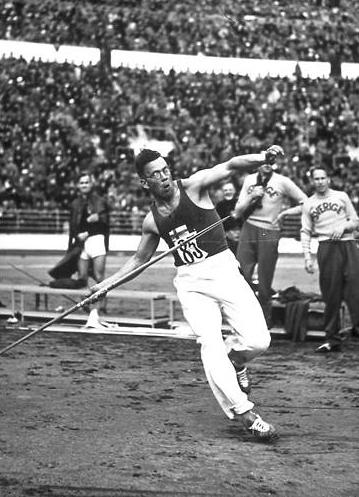
It’s especially true of athletes from smaller countries, some of which send only one or two athletes.
The Olympics therefore is more like an epic saga, with many smaller, faster stories taken place under its massive umbrella. There is a broad, overarching theme, at least on the surface, but I tune in, (as I imagine most do) to enjoy the nature of a given sport, and the personalities partaking in same.
It’s especially fun for me when, like this year, there is live action to be had late into the night in my time zone, given the time difference.
The American network, NBC is, for the most part, terrible with its coverage, and has been for a generation. Too much talk, too many side-pieces and documentaries, too much shoehorned poetry and false drama. They are especially problematic given that they now charge people money to see the lesser sports on their Peacock streaming nightmare. Not at all in the spirit of the Games.
Yet their hegemony is all we have available in the States, so I like my fellow citizens must rely on them to bring us any aspect of the Olympics.
My point is that even then, to the discerning eye, there are stories to be had, and not always the ones NBC is pushing.
My goal as a writer is to make sure all of my narrative is as enjoyable as a specific aspect of it is. The late night shot put coverage that nobody in prime time ever talks about should be as enjoyable and worth consuming as drama as is the opening ceremony. I don’t want my reader to have to go digging for the good stuff.
But when I am the reader, I try to find the good hidden within the enormity of the piece. If the plot is weak as a whole, (The entire Olympic movement) I give myself a chance to enjoy the relationship between the individual characters. (The live coverage of sports I don’t get to see much except during the Games, like fencing.)
In sport as well as in fiction, find and enjoy your own drama, suspense, emotion. It may or may not be what the author, or the genre intended, but it will be worth it for you in the end.
Active Observing
I used to think that observation of the world around was a passive endeavor. If I am at the library looking out the window and it starts to rain, I am observing the rain.
The older I get as a writer, the more I realize that this is not observing. At least it is not automatically observing. What I’ve described is seeing, or at best, noting the rain.
Observing requires a specific choice. Our attention as people has many dimensions, and though they often overlap, observation of something, and seeing/noting it activate distinct varieties of our attention.
To see something we need only be present, with our eyes, (or what we use for eyes) activated. That kind of attention is merely reflexive.
Observational attention entails, I think, some degree of questioning. The questions may not have answers, but they partner with what we see during a time of observation. That requires a conscious flip of a “switch” to a specific type of attention.
Even if you do not ask question about what you see, to observe is acknowledge detail, envision alternatives, absorb though insight that which is intangible but nonetheless logical about the scene before us.
Earlier in may life I would have considered this more attune to studying. And in a sense this is studying, but it is not so clinical, nor so laborious as a literal study of something. Studying has a specific agenda, whereas active an open observation exists for its own sake. Certainly we may learn through mere observation. Yet the purpose, in this context of observation, is to take in, to experience the wholeness the “all-ness” of what surrounds us.
“Mindfulness” as some spiritual practices call it.

Taking this definition into account, all writers must engage in active observation. There are other common, logical pieces of advice for the writer. Some so well trenched as to appear as requirements.
Maybe they are. Things like a writer must read a lot, or a writer must put “butt-in-chair.” (I hate that phraseology, but it is what it is.) It’s possible that without those pillars of the writing life one cannot write. Certainly both make is more likely to succeed.
Yet even the dogma of those two principles leave room for a sliver of doubt in my mind.
But observation? There is no doubt. I do not care what you observe actively, but if you do not choose to observe, truly, fundamentally observe on a regular basis, you almost certainly will not be able to write. Jot down, maybe, but not write.
This is my observation of the situation.

 Ty Unglebower