Second Look: Lodestone Crossing
It’s a long book of poetry. Experimental poetry. An oddity to end this series of looking back on my books, but such was the chronology.
Lodestone Crossing Is a long poem broken into smaller chapters, derived from several sessions of “blackout” poetry. It’s a process wherein one takes a preexisting text, and removes (or blacks out) words, so that the remaining words form the new piece. I played around with it a few summers ago, and became fascinated by the process, so I opted to make a full length intentional book of it.
This single volume consists of my “black outs” fro from different sources. Old magazines from the 50’s, a right wing religious advice book, a book about shoes, and one or two other things.
There is a lose running theme throughout the piece, but it’s mostly a”prose poem” as they say.
I don’t think most of it would make for good “slam”poetry, but that is closest analogy I have to the result. My goal was to create not only correct sentences, but to make the inevitably awkward diction of some sections into poetry itself. As much as the words and the meanings matter, with this project I paid particular attention, sometimes all the attention, to how the sentence sounded out loud.
You learn about language when you do this, on both a broad, official scale, and one’s own personal language preferences and tendencies. A real emphasis on the particular powers of a given part of speech.
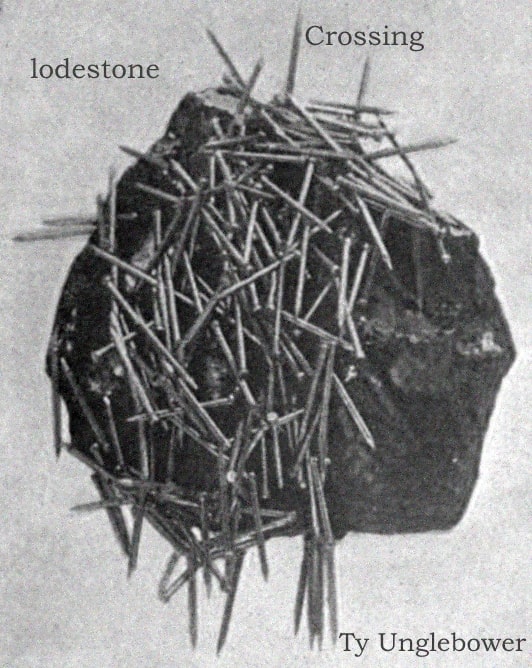
The cover is an old archival photo of a lodestone, (a naturally magnetic rock) picking up some nails. I thought this is sort of what black out poetry does. You wave your perception over something, and the “more valuable” components stick to it. Hence the title, Lodestone Crossing.
I will say that in this volume, I insisted on not only holding on to the word order, but to the punctuation of the original source. I could not end a sentence in the poem, unless I had a word in the original source that was followed by a period. Extra constrained.
I have since this experiment completed, but not yet typed a second, much longer “epic” length blackout poem. This second one is the result of a single enormous Right wing religious commentary I picked up at an old book store. In that, I did not constrain myself with punctuation–only word choice and order. I haven idea when that might be available; I mention it here only to emphasize how uncommon such a project is for me. Two, lifetime.
Look, I understand poetry as a whole is a hard sell in our society, and particularly poetry of this kind. I did this mostly for my own enjoyment, which I then wanted to share with anyone else who enjoys playing around with language without the constraints of standard English communication. (This kind of poetry is also sometimes known as “constrained writing.”) It’s for language lovers, or Ty lovers, and probably not many others.
Do I think that it can be enjoyed on its own? Yes, with an open mind one could, or else I would not have made it available for download. But because it is super niche, I realize it will likely remain an obscure piece even for me.
It’s a dollar.
*
This concludes my Second Look series. I’ve enjoyed looking back on my entire catalog, and sharing a few extras about each book with you. I hope I have convinced you to try some of them if not all of them. Selling is not an easy endeavor for folks such as myself. It’s particular difficult for my mind to condense everything good about my writing into one sentence of 30 seconds of talking. I do it because the system says I have to, but it felt good to talk for as long as I wanted about each book as I came to it. How I wish all marketing were that open and patient.
Second Look: 14 Fantastic Frederick County Writing Spots
This is my most niche of all my books. So much so I debated not including it in this series on second looks at my work. But for completeness sake, I will talk about it a little.
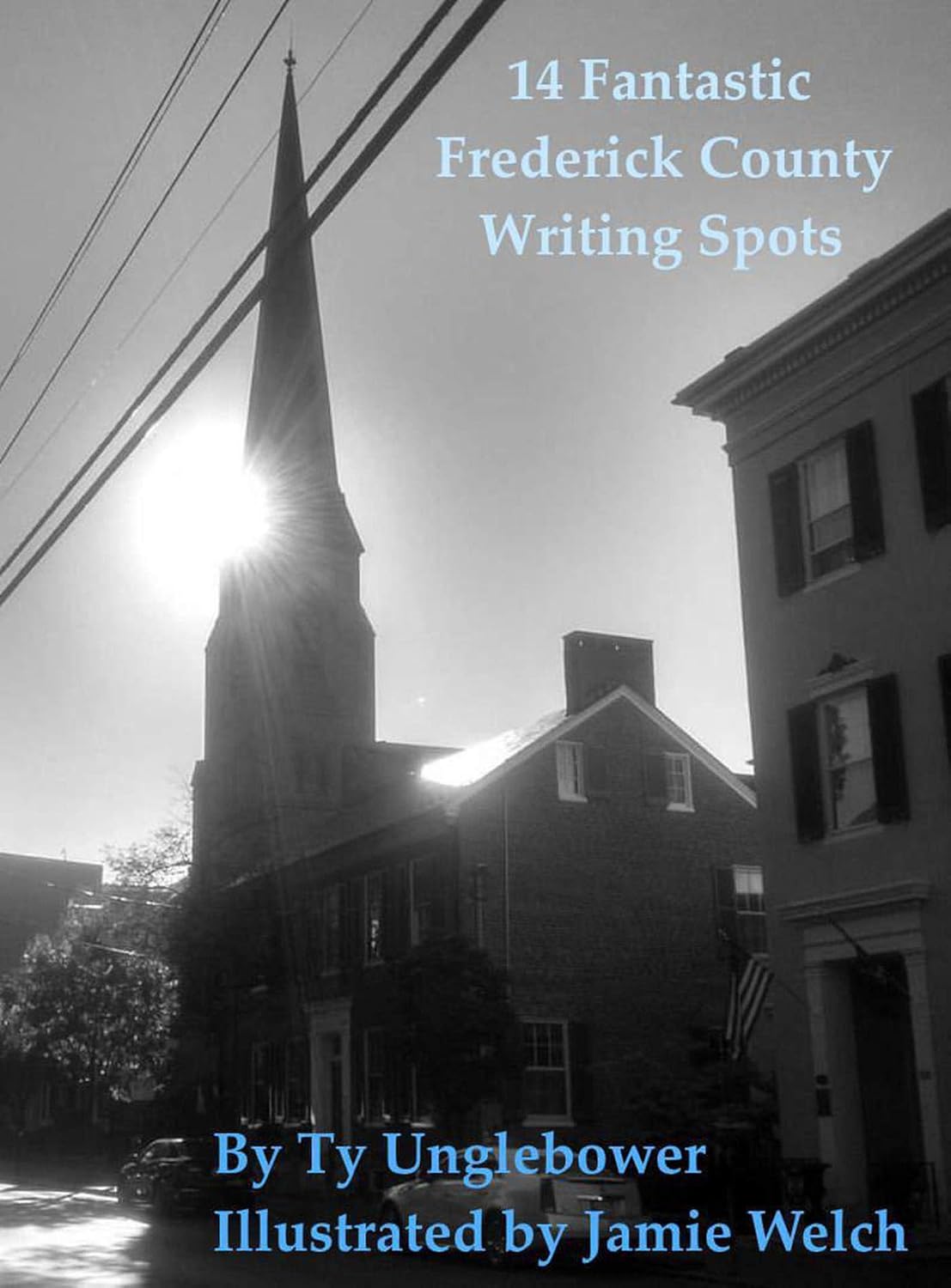
As the alliterative title suggests, this is a non-fiction short book about spots within my home of Frederick County, Maryland that I have found are particularly suited for a writing session. These are places generally outside of the standard coffee shop or library. Generally.
Naturally, a familiarity with the county makes the book more useful to a reader, I won’t deny that. I first came up with it thinking I could attract the attention of locals in particular, through various different groups and gatherings that (as often with me) did not quite pan out.
I did get a lovely review on this volume once from a local writer who did find it, somehow. I think they follow me on Goodreads. Because of that review I cannot call it my least read volume. But it is a close second.
Can anybody outside of Frederick County get anything from my descriptions of and reflections during my various visits to the locations described? It’s a hard sell, but yes, I believe that writers and to some extend creatives in general can find something to enjoy about the craft without the pages of this highly localized content. I assumed familiarity with the county when I wrote it, and said so in the introduction, but I nonetheless explore each location in a manner that would benefit those who have never been.
At heart it is a cozy writing book. I made every effort to connect experiences such as the rushing of Cunningham Falls or the back story of forgotten writer George Alfred Townsend among the ruins of his estate at Gathland State Park to the universal aspects of inspiration and motivation for the writer. To be there, (and of course to write) is to receive the full power of my essays in this collection, but an open mind and strong imagination will open the doors to anyone.
There are drawing in it, my only book to date with illustrations, by a friend of mine, Jamie, based on photographs I took myself.
I was partially, (not entirely) inspired to write something like this by one of my favorite writing books, A Writer’s Paris by Eric Maisel. In it, he describes living for a few months in Paris, and how to utilize the specific cultures a sights to aide one in a writing journey. I have read it more than once, and am inspired each time, despite having never been to Paris. (Or, despite Maisel’s pleas, having a great desire to ever go.) It may be an idealized Paris, I can’t say, but I can say I feel as though I am in Paris itself, scribbling into a notebook.
I won’t claim my volume is as sweeping or intimate as this one. Yet my goal is very similar: offer how the vistas and locations of my home county feel to a writer who has both been there, and to those who will likely never go.
Assuming that a reader is inspired to write because of these book, I will have achieved a great deal of my goal in writing it. On the other hand, if it only manages to convince the reader to some day visit Frederick County, that’s not so bad either.
14 Fantastic Frederick County Writing Spots is available in ebook form, for 99 cents in most ebook retailers.
Second Look: The Italics Are My Own
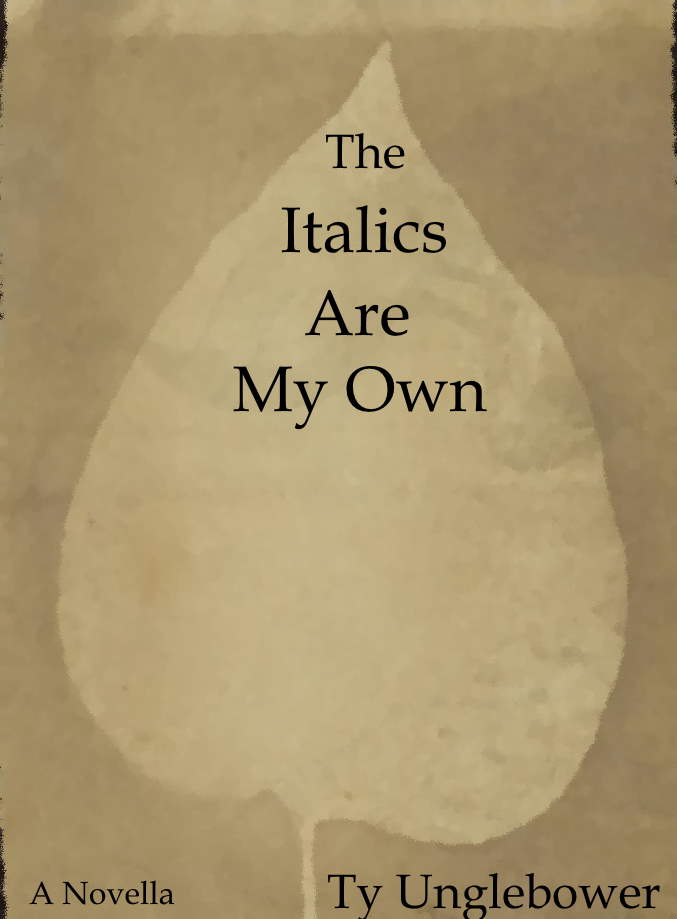
This novella is weird. Odd. Unconventional and difficult to describe. Experimental and dreamy, I knew when I conceived it that it would not be for everyone. In fact I knew it probably would be something very few people would look into, even once I started marketing it.
I wrote it anyway.
So why did I write in The Italics Are My Own?
Actually, how is the first question I should answer. I was determined to write something as wistful, poetic, and meandering as I damn well pleased. Though there is a light theme and a story to be told within it, this novella’s central purpose was language. I wanted to delve deeper into the sound and sequence of words and phrases in service of mood and setting, and to some degree character than I had ever done before. Mostly, I did it for me, hoping prose and language lovers out there might stumble on to it, and give it a chance.
Short of that, I wanted the concept to appeal to fans of ambiguity, non-linear narratives, and symbolism. Of allegory.
Four mysterious men meet one another at a cafe in search of a missing fifth among their number. Determined to locate their one-time fellow, they set off through a set of oneiric venues that for the reader borders on the edges of reality, but for them may be more believable.
Then, every other chapter we meet up with two men, one young, one older, who speak in script/dialogue form, their conversations becoming more sophisticated each time, and taking place in a more recognizable reality. How do they relate to the mission of the four mysterious men? You’d have to read it to see if you can detect it.
Other than to call it an “experiment” and a “language focused” book, I recognize there is little I can do to market this work, to date my strangest. There are light spoilers for it on this website, back during the time of its original release though, if you wanted to read those entries to give you a better idea before or after you give this oddity a try.
This is one of, if not the least purchased works in my entire catalog so far, and I suppose I see why. And I had hoped one or two people would have read it and offered thoughts on it by now. Perhaps you will be the first one to do so?
Not long enough to warrant the time and effort for a paperback, you can download this one for 99 cents from various ebook retailers.
Second Look: There Is Pain Here
To date the most full-fledge fantasy novel I’ve written is There Is Pain Here.
I’d call it a sort of historical fantasy, but for the fact that such refers to a specific and established subgenera with characteristics my novel does not have.
Nevertheless, it is a fantasy story, and the protagonist is a historical figure: the 20th president of the United States and victim of assassination, James Garfield.
The story is mostly set in the afterlife, or at least a version of a it. An in-between state for certain souls called “The Overlap.”
Upon his death bed, James is recruited to this state, to help fight malevolent forces that are bent on destroying or taking over not just that part of reality, but all parts.
But first he must learn to walk talk and fight as a spirit does in this realm, not as one would with a corporal body during life on earth.
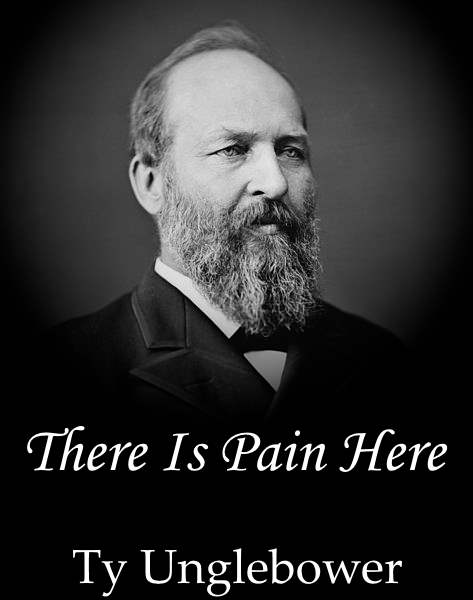
Garfield in our world is a more obscure figure now, but his tomb Cleveland, Ohio, (which I visited prior to finishing the book) is testament not just to his life, but to the esteem in which the country held him art the time of his death. (Being the second president felled by a bullet in living memory, after Lincoln.)
I had wanted to write a fantasy story featuring historical figures at some point, and had even made early notes for a different story with a different person. But something about Garfield, and the circumstances of his death won out.
A somewhat flawed man, I found him nonetheless fascinating in a number of ways. His brilliance with languages and mathematics. His stance on corruption in government. Some of his pithy quotations. His use of his advanced mind to navigate a whole new reality appealed to me. (Shifting his every day more than a few inches in this case…)
Plus, it is that relative obscurity that I mentioned that made him ideal for this tale. Lincoln himself is over done in fiction, and even in fantasy fiction. (He visits the bardo, fights vampires, etc,) No, a worthy but lesser known president, usually related to a pub trivia answer, was the type of presence I wanted in The Overlap.
More than anything else, however, his haunting last words sealed the deal. They are reported to have been, “There is pain here.” I asked myself what if he were not referring to his body, or even to an afterlife as we understood, but to the circumstances in The Overlap that convinced him he had to be of service to people there, if he could not longer serve the people on earth.
Hence the title.
It was quite freeing to world build without worrying about the accuracies of streets and roads, or even weather patterns and physics. The world could behave in whatever way I chose, and that was something I had not yet experimented with in novel form at the time.
And for fun, I even included a few historical notes at the end about the real Garfield and how he compared to my version, for which I did more research than usual for a novel.
The cover is simple a photo of the real Garfield that I put together myself. I thought about spending money once again to hire the same professional designer that I worked with for The Beacons I See, but for whatever reason that feel through, and the notion of the minimalist approach appealed to me.
I hope the whole book appeals to you. It is available in ebook form for $2.00 at present. There is a paperback version on Amazon for 7.00, though it has a different cover as in that case it was last minute to make it a paperback for the benefit of a specific party, and I saw no need to make it off the market after the fact.
Second Look: The Beacons I See
With this novel I return to the light fantasy elements of my first few works of fictions. The Beacons I See is a novel of many firsts/onlys as of this writing.
To begin with, it is the only work of fiction that came to me as the result of a dream.
Partially.
I’d fallen asleep in my chair watching TV, and woke up with the first sentence of this novel in my head, though I didn’t know it would be a novel yet. I liked the line enough to write it down right away. I was determined to start there and continue from it until what I wrote felt complete.
The result was this novel, one for which I had no outline of any kind at the start, and never wrote one. I wrote as it cane to me the entire time. The only novel in which I did so.
More firsts? Though in Flowers of Dionysus I had included multiple points of view, some of which were of women characters, they were in third person. Beacons is the only time I’ve written an entire novel in first person from the view of a female character. To that end it has been my only novel so far read by a sensitivity reader as they are called. A female friend of mine read a draft to see if I was in any way being accidentally unfair to a female perspective.
It features my Autistic protagonist.
Finally, is the only one of my novels with a cover designed 100% out of “house.” Most of the time I design at least part of a cover.
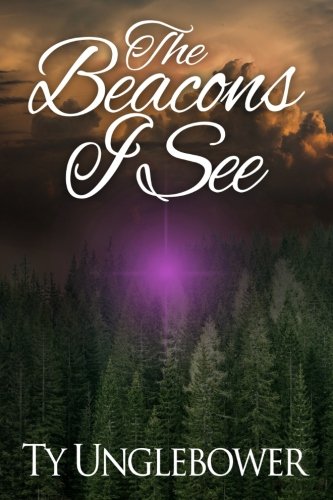
All of that makes for a unique book among my catalog in many ways. Yet even if all that were not so, I think it is both the most personal novel I’ve written, as well as the prose I am most proud of.
Vanessa can see remnants of promises made by people. They hang in various colored lights in the air where the soul stood when the promise was made. She comes from a long line of such “Seers.”
But oner day she is stunned to see one of those imprints of a promise high above the forest near her grandmother’s cabin. How in the world did somebody make a promise all the way up there? She makes it a point to look into this mystery herself.
The first full novel of mine (there’s a first I forgot to mention earlier) written after my official Autism diagnosis. I wanted to convey the nature of Autism in both a universal sense, and in a manner particularly suited to the main character. In this world of this story, Seers exist. Autistic people exist. Vanessa is the only currently known Seer that is also on the Spectrum.
A rare power in the mind of a neurotypical person is often explored in fiction. Yet once I started writing the first paragraph or so, I knew I wanted to explore what a rare power would look like in the not0so-typical mind of someone with Autism Spectrum Disorder.
I don’t consider Vanessa a hidden version of myself. She is calmer, more able to navigate certain situations, and probably in the end smarter than I am. On the other hand Vanessa needs more time to recover than I, and is probably out of commission when things do not go as planned to a greater degree than I am.
So we are not the same person. But Vanessa is among my brethren, as it were. Through her, I was able to tell a story not about Autism, but about a woman with a gift, and a mystery to solve that happens to have Autism. It was important to me in the wake of my official diagnosis to embrace fully what made folks with ASD different, without spotlighting it as freaky.
That is why it is my most personal novel as of now, even though all of my work is personal to some degree.
I wanted to reach fellow Autistic people that felt like me, or at least like Vanessa thought the course of her story. The usual marketing issues I mention all the time got in the way a bit, though I did my best. Maybe even more than usual, entering it into a forum in search of a review. (I barely ended with what I paid for.)
How very Autistic of me.
Nevertheless, by the numbers, though it trails for behind Murder, Theatre, Solitaire, at last check this novel is my second-most popular in terms of purchases. I like to think that at least some of those people are also on the Spectrum.
The ebook is currently prices any 2.00. The paperback you can get for 4.50.
In the off chance you decide you want to read one and only one of my books ever, (odd as that would be) make it this one.

 Ty Unglebower
