Frank Thoughts and Current Status
Confidence is important for any endeavor. And I have it when it comes to my writing about 90% of the time. (I don’t think any writer is 100% confident 100% of the time.) And I’m building confidence in my self-publishing abilities as the launch date for Thank You for Ten: Short Fiction About a Little Theater later this month approaches. (The 21st, mark your calendars!)
Even modest self-publishing is not for the weak-willed or the lazy, and I knew that going in. Each step I go through in the process, each new skill I learn, each new uncharted (for me) ground upon which I tread only serves to strengthen my self-publishing and marketing knowledge. My operation may be small for now, but it’s a stepping stone. I am more at ease with each passing week. It’s a net gain.
Yet I don’t believe in false confidence. I believe in being open with my concerns and my feelings and my anxieties about this. I realize that Marketing 101 would probably advise me to never indicate the slightest weakness within me. For not the first time, I’ll be ignoring what Marketing 101 suggests when I say that the closer I get to the 21st, the more nervous I get in some ways.
Things skidded on the road a bit when it came to the book’s cover, as you readers already know. With some help, I got the situation corrected in short order, but even once the spinning stops, there’s still some dizziness remaining, and that’s what it was like with the cover situation. That was also what it was like as I learned to format the manuscript. (A process I won’t be able to truly check until I actually upload the piece.) That was time consuming, and I check on that every few days to make sure I have everything even now. But it was a challenge to undertake for a while, even though it wasn’t as worrisome as I had feared.
But I did fear, and I do fear. Not mind-numbing existential fear of course, but this is a big deal. Yes it is a learning experience, and a few mistakes here and there are to be expected. They can be corrected. The next time I self-publish something after this, I will know more, and will be better. It will be faster. But none of that takes away from the immediate concerns of looking respectable the first time out in the time before people even read my book.
I see what I have yet to do, I read the advice, take in the success stories of luckier people than myself, or those with more resources, or those who are better at all of this publishing/marketing stuff than I am and sometimes I freeze for a few hours or a day or two. Do I have enough of a clue of what I am doing to get away with this? And even if I technically accomplish what I need, what sort of success will the book see? How will it make me feel?
I believe in the book, and in myself. Yet so much of this is new to me. Not just new, but in a sense foreign. I’m not just learning new skills, but new ways of thinking in regards to some ways. You can call it “getting outside of my comfort zone” if you want, though I hate that term. Whatever I call it, though, I confess to being a bit on edge about adopting entire new ways of thinking about process.
Now I won’t let the concern prevent me from moving on to the next step and the next. I can’t. Too much is invested, and the whole point is to make this all about what I have written, and about my eventual readers. (I hope all of you will get a copy.) Nobody will see the writing if I don’t do all of this stuff that overwhelms me a bit. And I’m not even doing everything that most people in the field suggest.
So with 19 days to go, I’m a bit anxious about it, even as I proceed to cover all of the bases, and seek advice from those who know better than myself. I’m anxious about getting right, getting it done in time, looking good as a self-publisher, nailing the technical specs, getting the word out. And that’s just the stuff before the actual reception the books gets.
Its going to happen, even if there is another slip on the order of the book cover. At some point in time, Thank You for Ten will be available for the world to buy and read. And when it is, I can rest somewhat easier. Yet until then, yes, I’m nervous at times. While some authors may not acknowledge that, I want part of what’s associated with my name to be frankness. I want people to appreciate my stories and my candor.
And now, I am off to look into how one formats for Amazon.
Anonymous Jane Interviews Me About “Thank You For Ten”
If you give them a chance, many authors can find something to say about their work for hours or days on end. To an extent this is necessary. Marketing is about 40% of being a writer these days, after all. But sometimes in order to prevent marketing and education about their work from devolving into repetitive rambling, an author needs specific questions to answer. Enter Anonymous Jane.
Not their real name, of course. But this trusted fellow creative and friend of mine agreed to my request to come up with questions for me about Thank You For Ten: Short Fiction About a Little Theater only if they could stay unnamed. The moniker “Anonymous Jane” was a compromise position between naming them, and referring to them simply as “anonymous” and she agreed. What you see below is the result of an instant message discussion. (Anonymous Jane hates the telephone even more than I do.)
Anonymous Jane, an artistic type in her own right, has read all of the stories in the collection. However, none of her questions, (or my answers) contain spoilers. I’ve not edited any of my answers or her questions just to make me look better, either, so bare that in mind, though once this was all together I did edit for original typos.
With that, and with public thanks again to her for her willingness to do this, I’ll hand this post over to her. (Her words being italicized.)
***
The stories in this collection obviously take place in a community theater. I know you spend a lot of time in community theaters. Is this all about the famous “write what you know” advice?
I’d by lying if I claimed theater wasn’t something I know a great deal about. I did it in college, and ever since then as well. Thirty or so productions at various venues over the years. A lot of that experience did of course inform the writing of these ten stories, but I wouldn’t say I set out to “write what I know” since I write about many things I haven’t experienced first hand. But when you’ve been a part of something for as long as I’ve been a part of theater, and it’s mostly a positive experience, you want to share with others the sort of feelings and thoughts and adventures and foibles that are particular to it. Plus the theater is fertile ground for drama both off the stage and on it.
Are you telling stories that are only possible in a theater, or do you think these sort of themes and moods could exist in stories set anywhere else?
Just about any story you write, no matter the setting or the time frame is going to have aspects that apply elsewhere, at least in spirit. If not, people would probably not read stories. Some great fiction is so specific, of course, that perhaps nothing of its beauty survives outside of its setting, but in most cases I think good fiction offers something to relate to outside of its own settings.
But I wouldn’t have written these stories as a collection if I didn’t think there were at least some issues unique to the theater, both good and bad. It’s those universal aspects of being human viewed through the particular lens of a setting that makes for the best fiction to me. I hope that I’ve struck a good balance between those universals and those particular quirks of both theater in general and the theater in these stories.
So what are some of those aspects of the stories that would be unique to the theater? And do you think readers will have to be theater people to get them?
I thought about that every time I sat down to work on these stories, and all the way through the editing process as well. Do I think a person needs to be intimate with theater in order to enjoy these stories? No, in the end I don’t. Nonetheless there’s some flavoring in this collection that theater people will be more likely to notice than those who have never been involved in a show. I don’t mean Easter eggs, I’m not trying to create a puzzle or hide anything for fellow theater geeks to solve or anything like that. I just mean there are a few nuances and cadences in the action and dialogue that probably play best within the theater, and may show up most clearly to those with a theater ear, as it were.
It’s like a lifelong professional fisher. They can look out to sea, notice certain clouds at certain times and be able to say with confidence that rain will come by afternoon, and deduce what kind of catch they can expect. Whereas the rest of us can see the same clouds, and even enjoy them, but don’t realize the nuance and implication of their presence on the fish.
As to what those things may be in the stories; it’s a little difficult for me to say. As I mentioned, I didn’t specifically set out to write stories saying, “this will really hit home with theater insiders if I throw this in.” I just tried to remain true to how being in the theatre has felt to me over the years, and allowed stories to spring up from that. My hope is that theater people will recognize it as their own when the read the stories, and that non-theater folks will appreciate it for what it is; part of a hopefully enjoyable story about a certain activity.
Most of what happens in these ten theater stories doesn’t happen on the stage. In fact as I recall most of the stories don’t even take place while plays are being performed. Did you do that on purpose?
For the most part, I can say yes to that. Had a wonderful story that took place entirely on the stage presented itself as I wrote, I would have of course still written and included it. But there is just so much that goes on inside a theater other than the actual performances. Physically the stage is just one fraction of even a small theater space. There are green rooms, dressing rooms, offices, lobbies, bathrooms, balconies, light booths and so on. Each of those places are crucial to the success of a play long before opening night. I think of all of the arts, theater may just have the largest portion of its iceberg under the water.
Add to that the various different types of people who are in and out of an average theater or arts center each day, for any number of reasons. Classes, setting lights, painting or office work. Hosting something, fixing something. Making plans for a future production or putting away an old one. So even aside from a performance on the stage, a theater is swirling with the agendas, visions, problems, desires and disasters of many creatives, each ripe with the potential for a good story. And that’s just in one theater! I could have called this collection “Thank You for Sixty” as far as that goes.
All of that goes into making a theatre space what it is. All of that combines to give the venue itself a character, even if the personalities within it don’t always get along.
Which brings up a good point. Part of the title of this collection is, Short Fiction About a Little Theater. The building itself is sort of the main character, isn’t it?
In a way, yes. And you’re right about the title, that’s no accident. Readers who have been involved in theater will without a doubt see some of their own venues and companies reflected in the events at the Little Dionysus Playhouse. At the same time I want this theater, like any theater in real life, to have its own traits and particular obstacles. The venue will often determine who comes around often and who avoids it. (If you think even amateur actors don’t choose certain venues over others, you’re wrong.) The venue will also by its nature dictate to an extent what happens inside of its rooms and on its stage. Combine that with what we were talking about before, the mixing of so many artistic and business personalities, and you’ve got a unique playhouse with which to work. It may not be clear on every page, but one of my goals was to convey to a reader of the entire collection how the specifics of the Little Dionysus Playhouse allow for the specific stories to unfold in the manner they do, thus revealing its own personality.
And you didn’t create this theater specifically for these stories, did you?
Technically, no. The LDP is the setting I created for a novel, Flowers of Dionysus which I hope to have out by the summer of 2015. But as I wrote that novel, the possibility of writing other stories that took place there was always appealing to me. Thank You for Ten is among other things a realization of that brainstorm. But these stories are not a prequel or sequel to the novel, per se. It’s a whole other collection of stories with different characters than the novel, and you don’t need to read the novel to enjoy them, or vice versa.
Is the LDP based on any of the theaters you’ve been in in real life?
It’s a sort of amalgam of a few of them. I based parts of it on one theater, parts of it on another, that sort of thing. But I also threw in unique features.
And the people?
How tricky can this get? But truly I suppose any character an author creates has something in common with someone the author knows. It may just be their wild hair, but something. People inform our ideas about other people, and that’s not so odd to me. You’re probably asking, though, if any characters in the stories are directly based on someone I actually know in their entirety, and the answer is not really. Just about any true theater person is going to have certain traits; we’re all a bit more perceptive, a bit more tolerant, we trend towards introversion and occasional moodiness. Most of us are tired by the time we even get to the theater. I’ve made use of those common characteristics throughout the stories, and like all authors I’ve borrowed a mannerism or two. But I can’t say that the protagonist in one story is a representation of my old acting professor or anything that specific, no.
Does anything, besides the theater and the venue unite all the stories?
Love, I think. Or at least passion. Dedication. Maybe that’s cheating on your question, but it’s that commitment to the idea of theater at the LDP that holds all of this together. Some of the stories show us frustrated people, or people that aren’t quite getting it right. A few times we see people that have never even been inside a theater before the events of the story. Will they ever come back? Some will and some won’t. But one thread that runs through all of the stories and basically all of the characters is that the LDP in particular and the theater in general can have an impact. If you give it a chance, if you open up to it in some way, as an actor, technician, board member or audience member, the theater can show us things about ourselves. It will revel secrets to those who are patient enough to receive them. The more you put into theater, the more you tend to get out of it, and what you get out of it tends to be positive more often than negative. That’s what keeps the characters and theater people in real life coming back over and over again despite the pitfalls.
If most readers come away with that after reading Thank You for Ten, I will have accomplished my goal.
I KNOW Memorial Day Is Not National Barbecue Day
I find myself each year resenting the reminders that are all over the internet that Memorial Day is “not National Barbecue Day”.
It’s condescending. I don’t need reminded of what today is.
I’m opposed to the mutually exclusive tone of those reminders. Are we incapable of having a barbecue and respecting the fallen at the same time? A day off is a rare thing for some people, so why can’t they enjoy it? Are we expected to fast and sit in a dark room all day because it is Memorial Day? Or on that day do we opt to partake in the pleasures and rights for which so many died in service to this country? Maybe people barbecue on this day off in tribute to those who will never again go to a barbecue and enjoy life. And even if that isn’t their direct motivation for firing up the grill on Memorial Day, I choose to believe most of the fallen would not be offended that someone opted to eat outside today and maybe even enjoy themselves.
Having a barbecue on Memorial Day is not dancing on somebody’s grave, yet that’s the impression some of the memes give off.
Speaking of graves, I’m offended at how often the “Just in case you forgot…” messages are accompanied by some picture, usually of a woman, draped over a coffin or a tombstone, or laying on top of a grave with a blanket. I can’t say nobody has ever done this, as people handle grief in their own way. But to begin with, how verifiable are most of those images? Do we know it really is somebody’s widow and that there’s anybody in that coffin? Furthermore does it matter? If it’s not authentic, it’s pretty screwed up to stage something like that in order to make some quick point. And it’s even worse if the photos are authentic. Who the hell is taking that picture, and making it available to the world? Who with a camera says, “I want to make sure I get a shot of this.”
But far worse than taking the picture is using it. Posting pictures of wailing widows and devastated children, authentic or not, and captioning them with a mini-sermon about having a barbecue is more offensive to me, and certainly more exploitative of the day than any picnic can be. Are we honoring the dead with those memes, or are we seeking acknowledgment of our own “honor” by sensationalizing on the backs of such images?
I do not need to be shocked into understanding Memorial Day. Nobody needs to, in fact. Those who are going to honor Memorial Day are going to even in the midst of a barbecue, and those who are not will not be convinced to change their minds because of some meme.
People are free to honor the fallen and respect this day in whatever way they choose. I myself choose the subtle, introspective route. And while I take that route I may be at a fun event or have a burger, it’s true. You or others may opt to be more quiet and somber all day long. It’s all acceptable. But let’s cool it with the judging of others with these framed guilt trips that we can fire off at the push of a button to our social media connections.
As a writer, I’m well aware of some of the things for which many people have died in service to the Constitution. Every word I write is a testament to that understanding, even if it isn’t on the forefront of my mind at any given moment. It’s a sacred right, to be allowed such self-expression as I partake in each day; it is a right that would not exist if not for the sacrifice of hundreds of thousands of lives over the years. I know it without the memes. I knew it before memes existed.
I also know of loss, as my father died when I was seven. He wasn’t in the service, but beyond a certain point, died is died, and I’m all too aware each day of what that can do to a family. Your annual retweet on the last Monday in May won’t reinforce that, believe me. It’s always there.
So, here’s to Memorial Day. Enjoy it with prayer or with beer and burgers. Or of course both at the same time if you like. Both are part of living in a free nation. Part of being alive in a free nation. And we, and the nation are alive because a lot of people are dead today.
See? I do know.
Cover Reveal! (Take 2)
When you self-publish, there is much to learn. Sometimes you learn a lesson well, and other times you understand the spirit of the lesson without properly executing them.
Such was the case for me in regards to the e-cover for my upcoming collection of short stories, Thank You For Ten: Short Fiction About a Little Theater.
On Monday, I revealed an e-cover I was proud of. One that I liked. One that I built upon a background image I had purchased from from an online store and designed by one Bee Javier. Taking to heart the lesson that simplicity is usually best for such things, I desired only to include some nicely formed letters on the cover image; the title and my name. Not only did this go well with my overall minimalist ascetic in life, but it kept me out of the thicket of totally designing my own cover. Unless you have experience doing so, you are advised against trying that. I had no problem adhering to that wisdom.
Yet the simple cover I unveiled on this blog on Monday (in a post I have since taken down) was not, it seems, suited for the purpose. That at least according to a fellow self-publisher. Though my own understanding of the instructions at the place of purchase indicated that the cover would suffice, it seems my addition to the image, simple as it was, was not suited for that purpose at all. Differences in appearance that seemed initially to me to be only a matter of viewing sizes adjusted for this blog were, it would appear, due to my design flaws in the file itself.
Even by choosing to be simple, I had not done it right. And this angered me on the day. Truth be told, I am still somewhat angry about it. The entire incident proved to me that despite research and thought put into every step of the decision, I didn’t understand the concepts properly. As a result, not only was my first cover ineffective, but I came out looking foolish for all the internet to see. The thrill of the reveal was short-lived to say the least.
Yet an e-book needs a cover, and mine needed one quickly. With just about a month before my launch date, (June 21, by the way), I had to release any loyalty I had to my original vision of the cover, and just get a good cover that fulfilled the technical requirements. Which meant the entire affair was above my pay-grade, to be frank.
Enter friend of mine, successful author and designer of her own e-covers, J. Lea López. (Author of Sorry’s Not Enough and Consenting Adults, both available now for download.)
As she has often done previously, she helped me clean and sort out a technical mess of my own creation. (See also: the “About This Site” section of this website.) She stepped in and after experimenting a bit and showing me some options, came up with an alternative cover for the collection that maintained the spirit of my original, even maintaining my original purchased background image.
Below is the cover she came up with, with proper technical aspects this time.
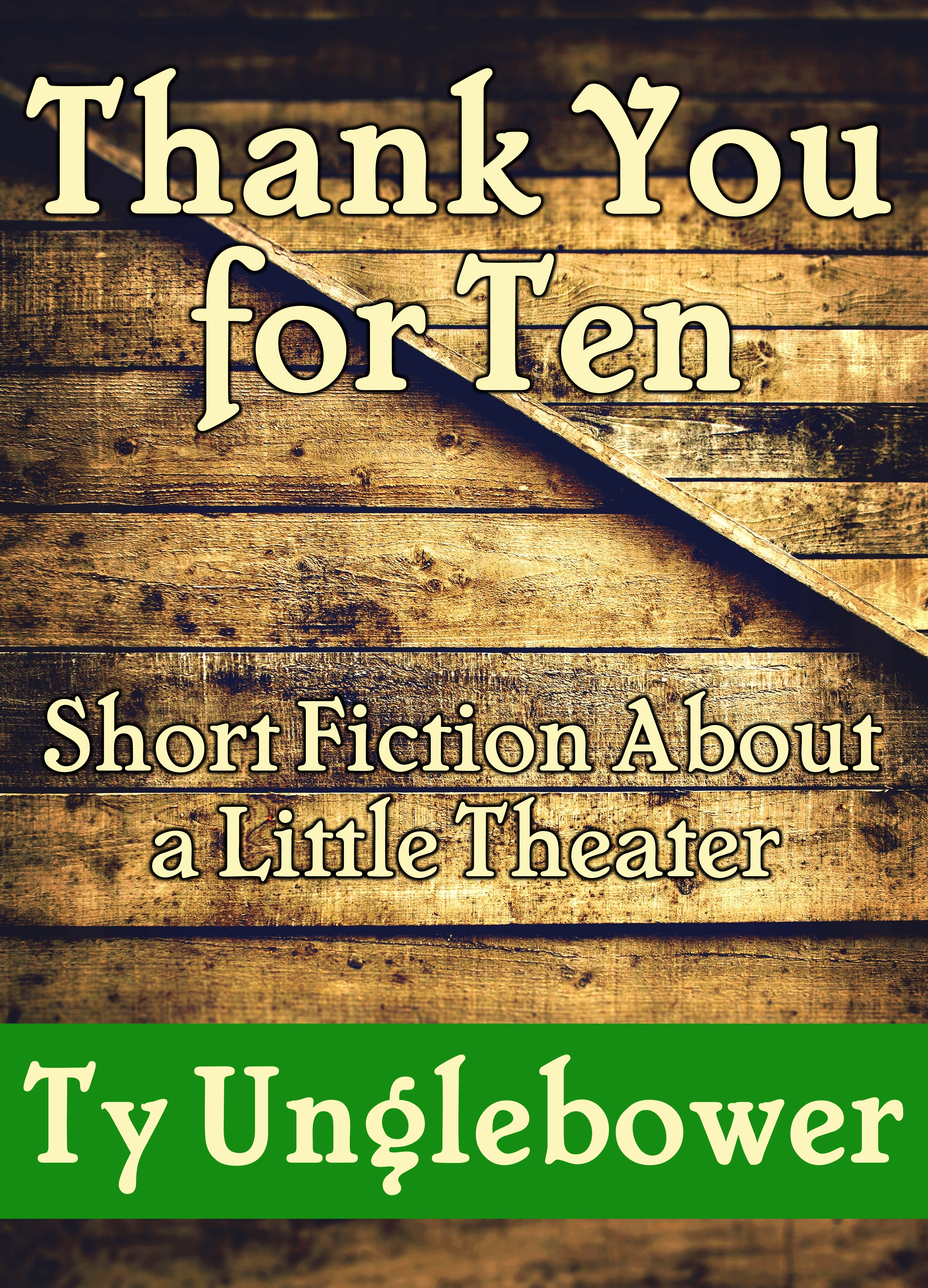
The Cover. For real this time.
The background image is representative of how stages were once constructed. Planks or boards were assembled to create the performance space. Though stages are not usually built this way today, and though the stage in my stories is not like this, the legacy of such early stages lives on in theater lingo. Even today you will sometimes hear stage acting referred to as “crossing the boards”. This background image embraces that metaphor.
The colors are earthy and organic. Minimalist. Much like my original concept. There is even some green to hearken back to a theater’s “green room”, which makes several appearances in the stories of this collection.
And there you have it. The now true and technically sound cover for the short story collection. My public thanks again to J. Lea López for taking the time to do some mop up. Do consider purchasing her fiction.
As for Thank You for Ten: Short Fiction About a Little Theater, it will be available for purchase and download starting June 21st from most of your favorite e-book retailers.
Negative? Negative.
Throughout my life, I’ve had issues with negativity. That’s a loaded statement, that can be taken any number of ways, depending on who reads it, and what their relationship to me happens to be. So, allow me to parse.
On the surface it sounds as though I’m admitting to being a negative person. I am not, and anybody who defines me in such a fashion has, for the most part, been too lazy to truly know me. Do I lean more towards the pessimistic (realist) side of many issues? I do. Am I afraid to explore my cynicism in a public, sometimes sardonic manner, by way of both the written and spoken word? I am not. Further, if I were to somehow parlay the expression of my sometimes bitter, sometimes darkly humorous, satiric but always sincere cynicism and skepticism into a full time career, I’d not at all be alone. Wide acclaim in writing and any number of other pursuits has been obtained in such ways.
Do I sometimes feel more depressed or anxious about certain situations than I should? Yes, and I’m exploring ways to deal with that. I am more easily discouraged than I’d like to be and on occasion some of my anger or irritation has been misdirected. This doesn’t happen as often as it once did, but it happens. I do my best to rectify it when it does. (Which is more than can be said for some of the previously mentioned lauded purveyors of biting wit in our society.)
I have been hurt and betrayed more than anyone else I know personally in my life. I have suffered more failures with fewer reasons and endured more than my share of bad luck. There are things that should be easy with which I struggle and have struggled for quite a while. My personal and emotional support network is uncommonly small, which this blog oft hath shown. If all of these circumstances conspire at times to make me weary of personal and societal bullshit, I’m going to say/write something about it. It might happen more often than those who are more fortunate than myself would opt to allow in their own lives, but it wouldn’t be the only difference between myself and such people.
Plus, cynicism can be fun to explore, if you’re with the right people. Are you telling me you do’t love reading bad reviews of movies you hated? You never make fun of a stupid song, or become indignant at hateful religious fervor? If you’ve ever enjoyed a rant of any kind, in person, on TV, in a movie, you’re in the same territory as I am here.
In other words, I am not accurately defined as a negative person. Yet that doesn’t stop people from applying that label anyway. And that is the second meaning of my opening sentence, as well as the one I must want to emphasize.
“Throughout my life, I’ve had issues with negativity,” in fact means that for years people have accused me of being a negative person, or being too immersed in negativity. People have stopped talking to me or broken up with me or refused to employ, consider, or even respect me because of it. (I assume so, in most cases based on others. Often I’m not given the satisfaction of a reason for people turning their backs on me.) In short, I’m sick of it.
If years of being made to feel like a second-class citizen by those who take it upon themselves to chastise me for my opinions and expressions thereof have taught me anything, it’s this; just about every person is as negative as I am about something or the other.
It’s a bit like the role of government in our broken politics today. No matter what any party tells you, nobody upon nobody is against the government being powerful. It’s simply a matter of what powers they wish the government to have. You’ll find many “small, weak government” advocates who insist that the government needs to outlaw certain sexual practices, or reproductive rights, or endorse a specific religious world view. They insist that the government be allowed to take the life of a human being, either in the desert or in the “clinical” confines of an execution room. Only powerful entities can do those things. So in point of fact a certain demographic wants the government to be powerful enough to have control over our lives. Of course they want that. They simply want that power to only affect those with whom they do not agree.
Negativity is the same. Unless you are a sage, a saint, or simply a psychological anomaly, you have things about which you would rant, or cry, or complain, if someone would but listen. Perhaps your support network is deep and wide and your negativity can dissipate faster than most. Perhaps you don’t keep a blog such as I do as a platform to share your feelings, or perhaps you don’t tell as many people about it as I might, in as many circumstances. But that is simply a matter of platform and volume, not a matter of being positive vs. negative. You know that something does push your buttons or tries your spirit. You cannot call it negativity when someone else expresses it, but allow it to be “responding” or “educating” or “venting” when it is your issue.
Ironically, many “positive thinking” disciples become quite negative when it comes to a specific subject; me. I’ll be more broad and say it’s negativity that’s gets to them. Countless times I have been told just how negative I am. How absurd, offensive, unbecoming, unnecessary, and wrong it is. How I, by my skepticism have reduced the quality of someone’s else life just be being open with my displeasure over things that bare zero connection to them. It’s as though I have poisoned some mythic life-force well from which such positive-thinking people draw their very will to live. Because of that, their own anger and finger pointed becomes justified, because, like the powers of the government, they are only problematic when applied to themselves as opposed to utilized by themselves.
Lots of people sure enjoy being negative about being negative, and I’m a bit fed up with it.
It would be one thing if such a position were countered with being positive about being positive. But the other patently ineffectual aspect of positive-thinking disciples is that they do not reward positivism in other people. They will avoid, chastise, label and disown someone who goes beyond their personal threshold of negativity, often in order to preserve their own “peace of mind.” But how often do the bestow praise and appreciation on those positive, uplifting, constructive things that people in their lives do? Speaking from experience, I can say, not often.
Say that I do broadcast my negativity more often than most. (Though I don’t.) A legitimate survey of the content I produce on all media will bare out that there are plenty of positives coming from me as well. On Twitter I Tweet articles about writing, science, religion. I share quotations. This blog has many posts concerning my writing journey, introversion, day to day enlightenment. I am in the process of self-publishing my first collection of fiction ever. i have a website for my poetry, much of which is upbeat, (though not all.) I’m writing both a one-man show I intend to perform, and a regular play I hope to produce, both of which I mention on a regular basis on all of my platforms. I post silly pictures of me enjoying a good beer or a good sandwich. I ask questions in hopes of starting conversations online. I write goofy status lines on Facebook solely for the purpose of making somebody or other laugh.
Most of those people that chastise me for my negativity have been silent on these things. They don’t ask about my progress, or like the status, or retweet the tweet. They don’t want to be involved, or point out to their friends that they know somebody who’s doing thus and so. They don’t comment on my blog. And worse yet, the biggest crock in all of this? Almost none of them ever, ever contacts me privately to tell me that they are proud of what I’m trying to do with my life, or to ask me how I’m feeling, or to just say “hi.” Not that I do these things just so people will applaud me. I do them because they are part of me. But if I’m not going to be cheered when I’m positive, what right has anyone to jeer me when I am negative?
That’s not negative? This is what “being a more positive person” entails? All of what I just mentioned is excluded from an assessment of who I am because I can say on multiple occasions that the Nationals are playing like shit, this commercial is obnoxious, Star Wars sucks or the service at the local Starbucks is terrible? All of that wiped away because I’m a bit louder and a bit more frank than the “positive” people are about their own problems? (Unless those problems are me.)
I’m not the most charming, the most charismatic, or the most handsome person within my own circle, let alone the world. For better or worse, I cannot buy into saying nothing when something has gotten under my saddle. So be annoyed at my occasional lack of tact, or the fact that I write a lot, or that I don’t always slide out of bed on a rainbow in the morning. I’ll cop to some degree to all of these things. But don’t dare declare me a “negative” person when you can’t be bothered to investigate my entire opus. Don’t presume to say nasty thing directly about me and my worldview that make me feel like shit in response to my nasty rants about piddling shit like movies, commercials or songs you happen to like. My balance may be your balance, but you might see that if you were not on a horse so high that your selective upbeat attitude is probably more due to a lack of oxygen than anything else.
I give the negative with the positive at times, yes. But I, Ty Unglebower, am not a negative person. And I’m positive of that.

 Ty Unglebower