Second Look: Thoughts I Wrote Down Because I Hate Talking to People
My first foray into publishing book length non-fiction was Thoughts I Wrote Down Because I Hate Talking to People. It’s a collection of thought pieces or life essays, most of which I kept light hearted, but not all.
It is the first work I published after my Autism diagnosis. As such, the Autistic perceptive on several topics is explored and acknowledged in full. Pure “me,” so to speak.
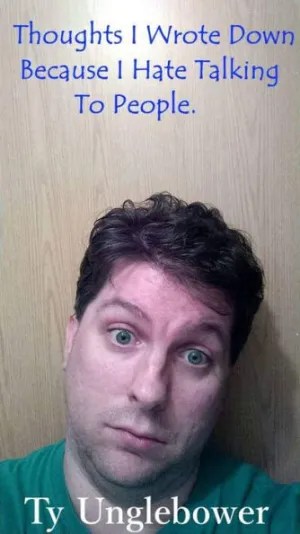
That explains the cover. Yes I was and am on a budget and cannot afford to hire a cover artist for every book right now. However in this case, I wanted the down to earth aesthetic and perplexed expression on my face to hint right away at what the reader will encounter within. Goofy as it is, I am still proud and amused by my minimalist choice here. Not to mention I did manage to capture how I feel much of the time as I navigate society, even if I rarely make such an obvious face as I do so.
I cover talking food, views from a local library, porn, vultures, (yes, the literal bird), and several other everyday topics. “Everyday” meaning that though I do touch on some deeper themes, I do so by way of a guy observing through the lens of his own life and his place on the Spectrum, even when I do not mention the Spectrum by name.
It is not a philosophical treatise on anything. I wrote it in hopes of both reaching out to others with ASD, but also offering what I hope are thought-provoking takes on topics that most people have experienced to some degree.
Even by my own standards I did not promote this one heavily. I knew going in it was likely not going to be a “hit” per se, and I was fine with that. I wanted it to find a specific audience of simpatico folks.
I am not sure if it did, there are not many reviews of it. I can however say that one or two copies get downloaded per year even now. Nothing worth noting in the business department, but it does indicate interest for someone on a regular if periodic basis. As always I wish I had some more positive reviews on the book, but if it is reaching those who think as I do on at least some of the topics I raise, I am happy to have written it.
I won’t claim the mask is entirely off within those pages, but it is a good place to start if you want to get to know me as a person and not just as an author.
In ebook form only, but now free of charge.
Second Look: Order! Ten Stories, Ten Very Different Meetings
From my top selling murder mystery title last week, to my little thought of short story collection. This week’s second look focuses on Order! Ten Stories, Ten Very Different Meetings.
I smile when I think of this short volume. Not merely because it was a [particular delight to write, though that is of course part of the reason.
More to the point, there was no intentional nod towards my Autism in it, and I may have published it before my official diagnosis. The dates in this case are a bit fuzzy. I only bring it up here because the theme is quite ASD of me, even if the action was not.
The title just screams, almost literally, about a concept beloved of almost every person on the Spectrum: order.
In this case, specifically Robert’s Rules of Parliamentary Procedure–the long time, though occasionally updated blueprint by which most proper deliberative bodies conduct their meetings to this day.
I was gifted a copy of Robert’s Rules–an antique nearly 80 years old, because of my known interest in parliamentary order as both a concept in real life and as a light-special focus. Reading through it on a regular basis inspired an idea.
No, I don’t have the entirety of it memorized. I would however commit it all to memory if it meant I would never again be required to attend a chaotic, unfocused meeting of any kind. I felt then, and still do, that a lot more in the world would get done if more events were conducted according to at least some of Robert’s Rules.
That of course is a dream. Even places that are supposed to use Robert’s Rules often end up ignoring them.
But what if there were a group of stories where the procedure was properly followed, better or worse, by everyone involved? Could short fiction sustain such a theme as parliamentary procedure?
To answer that question, and to give form to my preoccupation with different aspects of Robert’s Rules that don’t often come up, I set out to write such stories. I determined if I could not sustain ten stories or various genres, I’d give up the idea.
A few months and many careful flippings through the pages of my old copy or Robert’s Rules later, and I had myself a collection.
It is only available in e-book, as I thought the brevity of the piece probably did not warrant all of the fuss and bother, (and in some cases the money) to create a paperback of same. And as you can probably tell, I did not hire a cover artist. That etching of 18th century men arguing was too much to resist. It hit the entire mood of the collection on the head. (With a gavel.) As soon as I saw it was a public domain image, I knew it would be the cover, despite some advice from others.
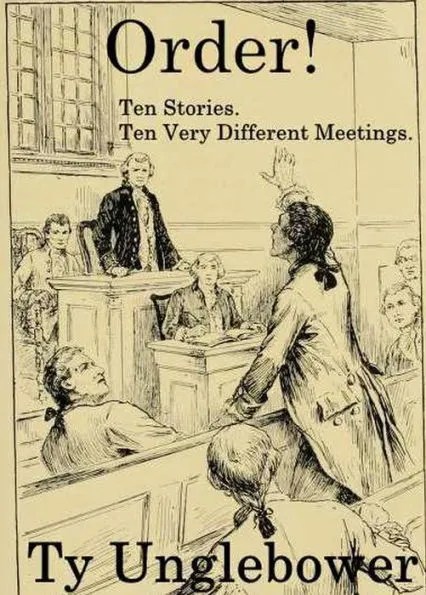
The appalled dude looking back from the front bench was worth the price of admission for me.
As with Thank You For Ten, I endeavored to cover several genres. There is sci-fi. Comedy. Mystery(ish.) I even managed to throw a Western in there for good measure, my only such fiction to date. (Though I am sure it does not literally qualify as a Western.)
It’s not merely a bunch of people having a meeting, though. That would be even more boring to read about than to sit through in person. My goal was to home in on (mostly) obscure possibilities or tactics that one could use, (albeit not always in good faith) to make something, or stop something from happening. The goal of the characters is always the focus.
In some ways, the theme of parliamentary meetings aided the plot, if you can believe that. The whole purpose of such rules is for any given person to put forth a very specific motion, and provide reasons for its acceptance, while others may provide reasons for its rejection. I simplify both the stories and the nature of Robert’s Rules when I say that, but in the broadest sense its true. The best stories, like the most disciplined meetings, are about people striving to get something, while someone or something else may strive to prevent it.
Put it another way, in a meeting, everyone is the protagonist. That might have made an interesting tagline for this collection now that I think of it.
Order! is currently free to download, and will probably always remain so. It was a fun jaunt over a year or so while I worked toward the release of the next novel. I had a great deal of fun writing these, and I hope you will give it a chance and have some fun as well.
Do I hear any objections?
Second Look: Murder. Theatre. Solitaire.
My second novel was not supposed to be either my second, or a (public) novel.
I had begun my so called sophomore effort more than once, rewritten it, changed ideas. It felt like an idea I could work with at first, but as year two passed and I still had not gotten any momentum for the project, I made the difficult decision to put it in a drawer.
By this time I had “won” the famous NANOWRIMO challenge multiple times. But I had yet to write an entire plot during the 30 day period. My previous wins had been merely word count success, never a full story to tell.
I had made that a goal of mine, to up the ante during the previous November. I did it. I wrote a whole novel, start to finish of at least 50,000 words 30 days. It existed.
Given that I had long planned to have a novel published again by the end of that current year, and that I had given up on the “official” story, I opted to take the Nano draft and revise/edit it for public consumption.
My first, and to date only murder mystery, Murder. Theatre. Solitaire. was that novel.
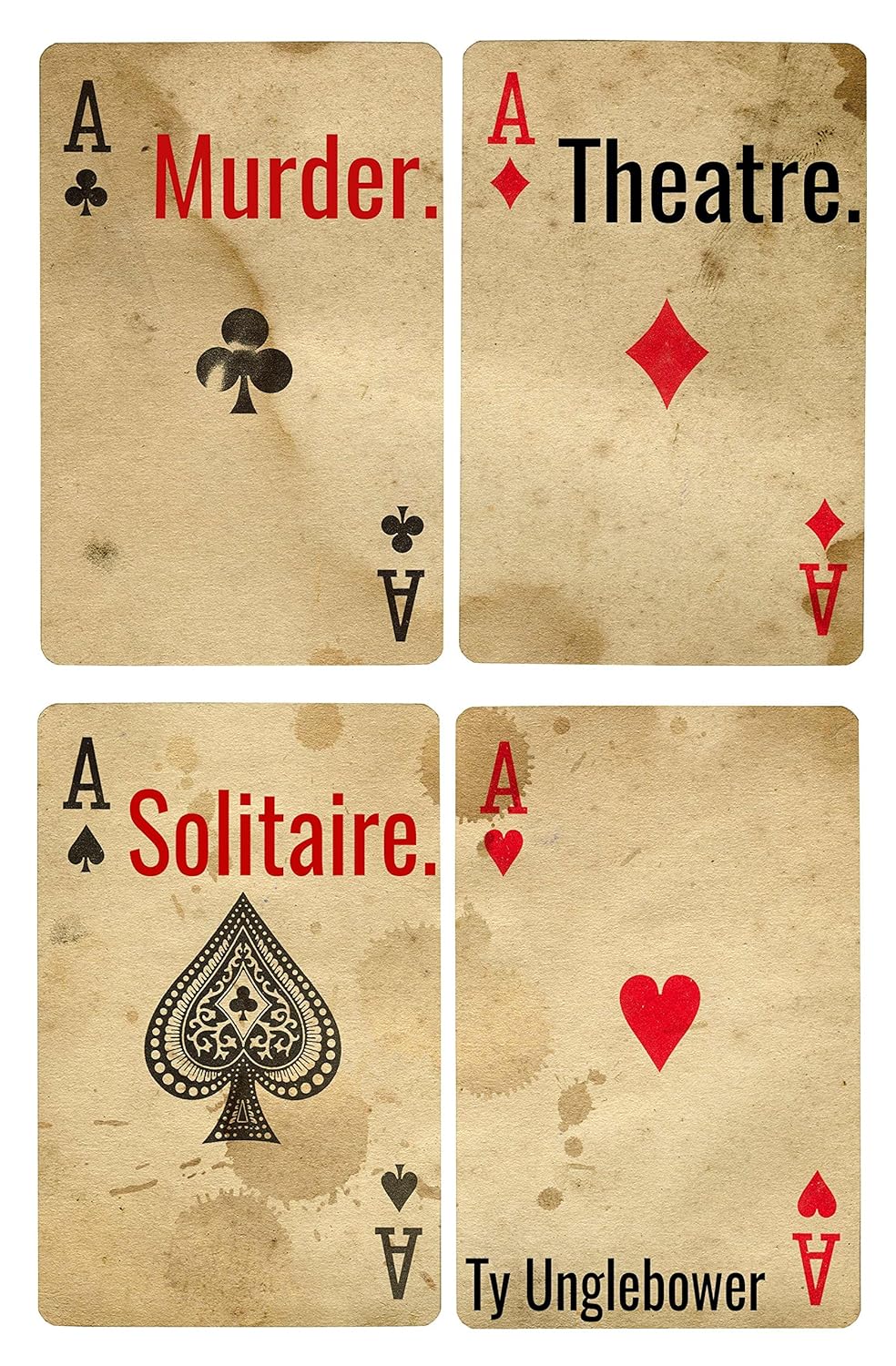
I am particularly proud of what I accomplished in such a short time with this one, even though I did not set out to publish it. The copy available is not the first draft written during Nanowrimo, but it is surprisingly close to it.
It’s a so-called “cozy” mystery. At least it is “cozy-adjacent” to coin a term, because true fans may note nuances that exclude it from the genre. Nevertheless is is a murder mystery that fits many of the criteria.
In the novel, Milton is a burned out theatre director. (Yes, I dipped into theatre again and not for the final time.) His sister insisted he take a retreat into the Vermont mountains for some time to unwind. But when a huge snowstorm half buries the retreat house, and the seven other guests, there is no way to escape from the escape.
And when the soon-to-be-owner of the property, all swagger and no brain ends up dead, Milton feels called upon to use his insight into human behavior, honed from years or scripts, shows and divas to piece together who, how, and why the man killed.
And to keep everyone safe until the police can get to them from whichever of the guests may be responsible for the crime.
And you may have guessed by now, in his spare time, to help him think and relax, Milton plays solitaire. Lots and lots of solitaire.
This single point of view narrative (Milton’s) does make reference to theatre truisms and tendencies. Unlike my first novel, however, it is not about theatre itself. Theatre knowledge and experience contribute to the proceedings, that is the point, but they are not centered here.
The same with humor. I was not at all interested in gritty procedural. While most of us have not, and hopefully ever will find themselves part of a murder investigation, I wanted to present, as many cozy mysteries do, a group of normal people and their reactions to such a situation. Again, I call attention to my author tagline, “I shift the everyday a few inches.” In the case of overworked Milton and the other disparate folks that have been snowed in together, their lives in a fancy mountain retreat tend to carry on normally in many ways, except for, oops, there has been a murder. (A shift of more than an inch to us, but to them, perhaps, no more than a persistent bad dream from which they cannot awake.
At least until the snow melts.
The elderly proper caretaker of the estate. Her young aide with seeming learning difficulties. The married couple that has seen happier days, a bubbly cockney girl, and a highly respected elderly rabbi. This cast of characters ponders, investigates, dares, cajoles, and suspects throughout the story, all while the corpse of the departed is kept preserved in the stone observation tower nearby in the sub-zero Vermont New England winter temperatures.
And for the sensitive reader, I will point out that while it is a murder mystery, and said body does feature into the investigation, I have kept gore to a minimum. I wasn’t interested in telling the story of Milton and his attempts to decipher what had happened, not in describing such things.
To date, Murder. Theatre. Solitaire. is, according to my reports, my most popular best-selling book. I hope you will be the next to consider buying a copy, and rating it well on Amazon and other such places.
Second Look: Flowers of Dionysus
My first novel could have been my last.
I had always written non-fiction, mostly articles and essays, a letter to the editor, with some poetry mixed here and there. I dabbled in short fiction over the years, but never did anything with it.
I had also attempted to write a novel a few times in previous years, but it never panned out. For whatever reason I could not follow through in most cases.
So there was a time in the writing of this novel that I thought I would get this story out, look into this self-publishing idea, and move on with my life.
Why was I so determined to not only finish but to present this one after so many false starts over the years?Two main reasons.
First I had recently done NANOWRIMO for the first time, and “won.” If nothing else it showed me that I could in fact finish a larger project if I did not take the time to edit until I was finished with a first draft. Revolutionized the way I wrote from then on out. The concept of a novel, which I only dipped my toe into for years was now at least a possibility.
Secondly, (and I have talked of this years ago on this site) I felt I was inspired by several events because of the presence of the “beyond.” You may interpret that as you wish, but in any event the ending scene of a novel “came” to me after seeing an outdoor production of Taming of the Shew that happened near my apartment of the time.
Now, it took a while to determine how and why and who would get to that ending, but that was why I was writing the story.
As with Thank You For Ten (which actually came AFTER the idea for the novel) the theatre in question is The Little Dionysus Playhouse, a composite of several theaters I have worked in over the years. It’s a small, aging playhouse that may be past its prime in this day and age, but nonetheless continues as a noted arts presence in the small (fictional) city in which the story unfolds.
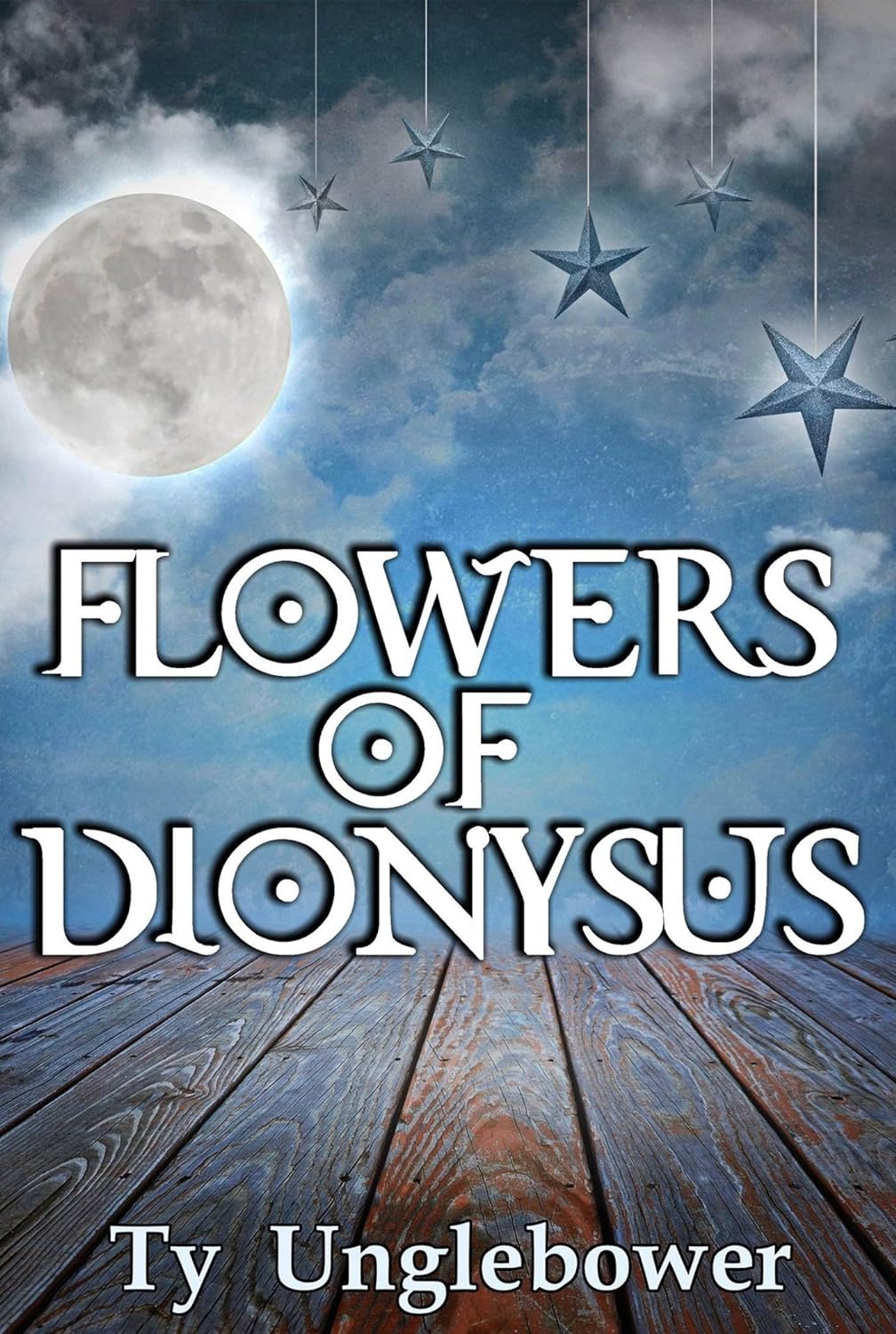
The protagonist, Matthias, was once heavily into theatre after studying it in college, though when the novel opens, he’s become a bit cynical of the entire concept. Sadly, his heart is just not in it anymore. It’s only as a favor to a friend of his that is directing a show that he steps in to fill in a missing role, his first in about two years.
Several smaller but thematically related subplots are woven into this story, all covering some aspects of the performing arts and featuring other volunteers involved in this same summer show, (a modern take on an old Greek Tragedy.)
This so far is my only novel with multiple points of view. Back then as now, I am not the biggest fan of reading multiple-pov. Yet I modeled this on the few novels I have been able to enjoy that used such a format: namely having only one point of view per chapter, and each chapter named after the character we are following.
We have Matthias, the burned out actor who has lost some of his fire. We have the disciplined weary stage manager, one of Matthias best friends. We have a talented dancer brought in to choreograph some of the fanciful scenes, and the “ingenue-adjacent” first time actress, introverted and unused to chaos.
The antagonist, the temporary executive director of the theatre rounds out the group of those with their own POV.
The production is troubled, behind schedule, weighed down by people half-assing their involvement. (If you have done community theatre, you’ve been in one of these.) Needless to say this does little for Matthias’ cynicism. Out of duty he will not quit this show, but he may just declare it his last.
Until supernatural, unexplained events and odd strangers start to pop up everywhere on the perimeter of the rehearsal process. Only Matthias seems concerned about it.
Will his need to figure out the unexplained help or hurt the production? His own commitment to theatre itself?
That’s Flowers of Dionysus. In the end, it is a love letter to the world of theatre, particular amateur/community theatre, albeit with some mild fantasy elements. I never felt one had to be involved in theatre to enjoy the story, but I can confirm theatre geeks will understand a few more of the “inside” jokes I throw in from time to time.
I want it to appeal to artists of all kinds, to people who believe in the power of same. Found family lovers will find something to embrace in this tale of friendship as well. So will those who feel burdened by cynicism at the time of reading, but wish to lift said burden.
Those who believe, or who want to believe that the intangibles of creativity, inspiration, love and the transcendent matter in this world take heed: they matter in Flowers of Dionysus.
I believe that I have improved as a writer since this first public attempt at a novel. I would hope so; one should always strive to be better. Yet I am still proud of this finished product. To some degree all of my novels follow in the spirit of my author tagline, “I Shift the Every Day a Few Inches,” but this debut of mine may embody it the most. To read this novel is to see (I hope) what I mean by that.
Second Look: Thank You For Ten
My short story collection, Thank You For Ten: Short Fiction About a Little Theatre was not the first idea I had to publish fiction. It was related to that, however, and ultimately was the first thing I ever published.
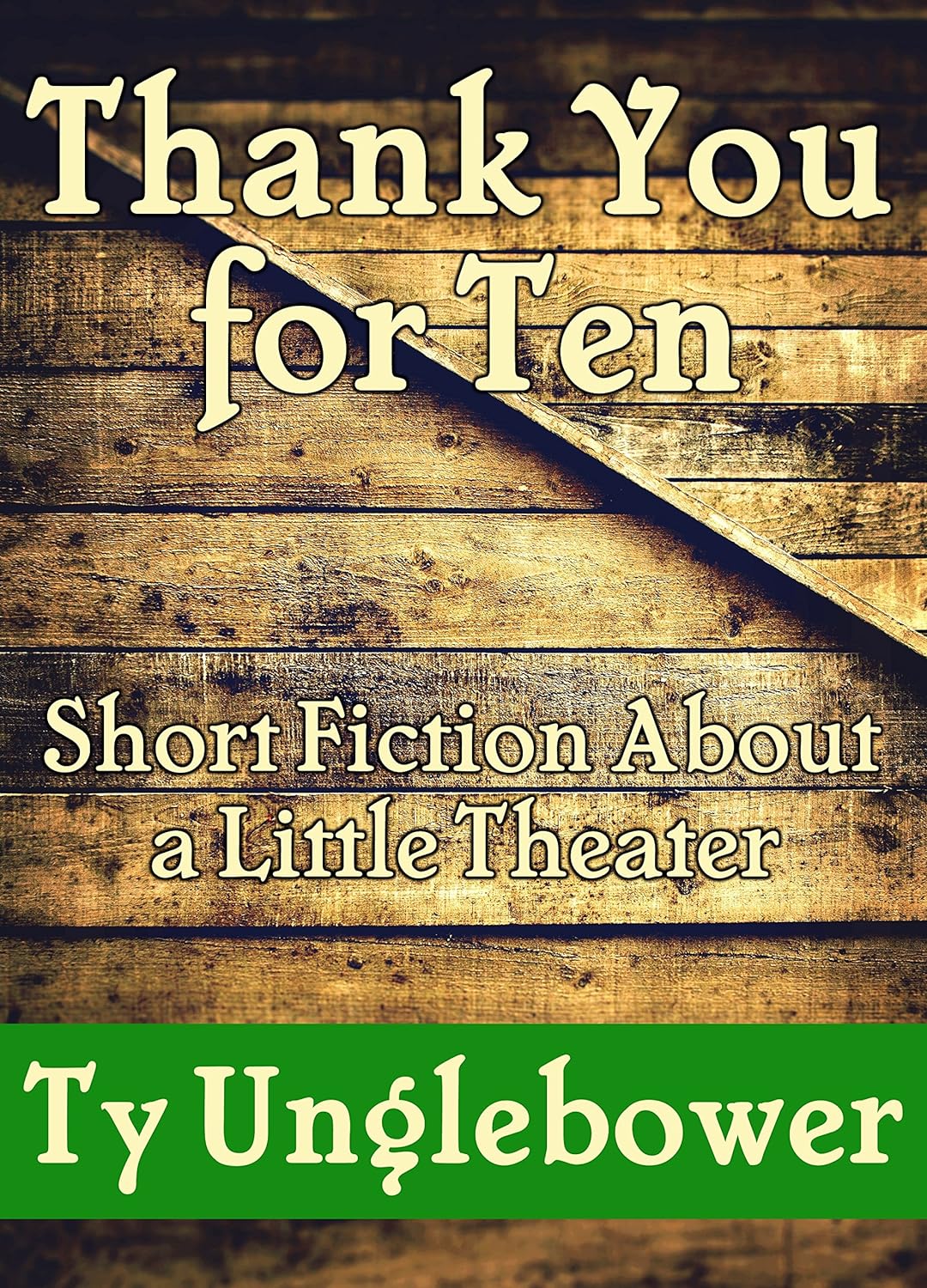
This collection of ten short stories not only share a setting with one another, but with my first novel, Flowers of Dionysus, which I will talk about next time.
I was both woefully and perhaps blissfully ignorant at how ineffective I would be at marketing and promotion. Or, I overestimated how much interest the setting would generate among readers. In any event, I wrote and published this collection as a companion piece to build interest in my upcoming first novel.
It was also my first ever experience was publishing my own work. It was a far more meticulous and thus nerve wracking process back then as compared to what I do now. But that’s boring to talk about.
The setting of the stories and the subsequent novel is small community theatre called The Little Dionysus Playhouse. The characters call it the LDP for short. It’s an amalgam of the various theatre venues I’ve performed in over the years.
As a long time volunteer actor I have come to realize that each theatre has its own distinct personality, based on resources, material produced, and various factors, not the least of which is the venue itself. Ask a one who has done more than a little bit of theatre, and they will tell you that the venue is often a character itself in any show. I wanted to establish the particulars of the LDP in both the stories and the novel.
I did so, but as it turned out Thank You For Ten became as much about what theaters have in common as it did the specifics of a specific place.
In these stories I explored such tribulations as not having enough crew to run a show, people flaking out, the eerie but exciting feeling of being in a theatre by ones self at night, almost-universal presence of summer classes, and just the overall pains-in-the-ass that seem unique to the theatre world. (How and why do we need to carry a boat through town for this production? And if we do have to, why is the place not unlocked as was promised on the day we took to do so??)
The stories nod towards various genres, even if they would not officially qualify in the minds of respective fandoms. I wanted to give a taste of different types of stories with a theatre as the setting. To put it another way, I wanted to give theatre kid/nerds among my readers a few minutes of sci-fi, a few minutes of suspense and so on, without having to divert from the recognizable (to them) glories and foibles of the theatre, with an emphasis on amateur production.
I had hoped when writing these, as well as the main novel, to appeal especially to theatre nerds, as I mentioned. 85% of my friends and allies are so because of theatre, and I figured it was an excellent setting to begin my foray into publishing fully realized fiction. (That, and having a sort of vision, but that is for next week’s post.)
To be fair, some of my theatre people did read the collection. But not many. At least not in its initial run. It is not too late of course for anybody with an e-reader to check out these stories. (The link is above at the start of this post.) Yet at the time I thought I could capture the niche of readers that were also the niche of theatre. We are a particular breed after all, we theatre geeks. My hope was to compose a sort of love letter to theatre people that would also make an enjoyable set of stories for those who came into the collection not knowing a proscenium from a prologue. The point was to wink at those who knew, and shake hands with those who did not.
Did I succeed?
That of course depends on one’s definition. I still get about one download a year for the collection. Yet ti did not, thus far, find its way to the theatre geek crowd as I had hoped. I can’t say if this is because I, once again, am just not effective promoter despite my best exhausting efforts, or if theatre geeks do not in fact want to read about the adventures of other theatre geeks as much as I assumed.
If I choose the optimistic approach, I can tell myself they prefer hard copies, and I only ever made this collection available in ebook form. Or perhaps many have enjoyed it, but have left no ratings or reviews for same.
When it comes to title matching vibe, this may be my best choice, honestly. It fits, it has multiple meanings, and calls out (in theory) to those in the know.
As with my entire back catalog, it remains available. If you should see this, and want to visit the LDP in shorter bits, with literally and figuratively a diverse cast of characters all doing their best to make promising enjoyable theatre, download a copy today.
And if you like it, especially if you’re a theatre type, do leave a rating. If 100 theatre people read and enjoy it, I am just as happy if not more so than if 200 people who do not know theatre do so.
But all of course are welcome.

 Ty Unglebower