Coming Soon: My First Non-Fiction
My third novel will be published sometime this summer, but before that, (on an as yet undetermined launch date) I will publish my first book of non-fiction. It’s called, Thoughts I Wrote Down Because I Hate Talking To People.
Snarky, no?
It will be a collection of about 20 informal essays, written by yours truly. It consists of my thoughts and general observations on such things as food, library visits, body language and even an apartment I used to live in, among other topics.
It will also have swear words. I know that may shock some of you, but I was determined, when I started this project, to write my thoughts in the manner I would speak them, and that does include profanity. Not, in my opinion gratuitous profanity for its own sake, but profanity nonetheless. Sometimes an adult uses profanity when the express thoughts, what can I say?
Might not be a bad thing at that; it may mean I’m more honest than most people, according to a recent study or two.
But profanity isn’t the point of the collection, nor of this post. It’s all by way of saying that the collection, which I hope will be equal parts humor and insight, sarcasm and reflection is pure me, if you will. I will be editing it for quality of course, but I told myself from the beginning that whatever essay I chose to write would not be censored, for language, length or topic. The purpose of the collection on the whole, however, is to get to know a bit more about me, and they way I think, by means of the written word. (One of my strengths, after all.)
In the course of getting to know me, I hope readers will also come to recognize a bit of themselves. Some of the topics I feel are universal, others are particular to me, but all are sincere and straightforward, what I call “informed meanderings,” which I hope will at least give pause for a laugh or a thought.
Because I’m not famous at this time, I realize people won’t be lining up to get a slice of my thoughts. So it will probably be free. (I’ve not worked out the marketing preferences yet.) Perhaps if a few people get a feel for how I think on random topics and enjoy it, their want to check out my fiction as well.
If not, though, I can still hang my hat on my candor this time around.
So keep checking back for updates, including cover reveal, launch date announcement, and so on.
Ramblings on Audio Novels
Earlier this week I finished listening to the novel Glory Over Everything by Kathleen Grissom. I liked it for the most part, despite flaws. Here’s my brief review.
I often ask myself, when I consume an audio book, (one does not “read” them of course) if I would have liked reading it as much as I enjoyed listening to it. Or more, or less? There’s no way to be certain, because once I’ve gotten through a book in one format, I’m not likely to then go through it again on another format. Even if I did, it’s only new once.
Yet I want to look closer at this concept. How does audio affect my enjoyment of a book?
To begin with, no matter what book, I get through it faster when I listen. I am a notoriously slow reader. So if time is in any way a factor, it’s the audio version hands down.
Yet a poor reader can dampen the experience. If I have to listen to someone with a terrible voice or no sense of vocal variance read me a novel, I’d probably be just as happy to read it to myself, albeit slower.
However, a good actor cannot save bad material. I may stick with a lousy novel a little longer on audio if the reading is good, but I’ve come to believe that no matter how talented the vocal artist is, they cannot make up for a lousy novel. Lousy will come through if it’s there.
You might ask the reverse question; can a poor vocal performance ruin what would otherwise be a good novel? That’s a bit more difficult to say. Though even Hamlet would probably be tortuous if Gilbert Gottfried yelled it at me, I suspect I’d be more patient with great material read poorly, than I would poor material read expertly. (Though I’d probably end up switching to a hard copy if I found the book that good, and the reader that bad.
Glory Over Everything was made more palatable by the decent performances. But it’s one of those books that I admit I probably wouldn’t have finished had I been reading. It does get wordy at times, as many novels do. I’ll put up with wordy for longer on audio, assuming the narration is at least adequate. The wrong kind of wordiness on paper either gives me a literal headache or puts me to sleep.
A poorer narration would have probably done me in as well.
A common complaint I hear from people who don’t like audio books is that they like to hear the voices in their head. Characters talk a certain way in their imagination, and hearing a book read to them ruins that. That’s a fair enough point for those it applies to, but I’ve never had that problem. I guess I’m not as in love with the voices I create in my head when I read a book. Sometimes the voice I hear narrating is my own anyway, if I hear any at all.
In short, being read to doesn’t ruin my imagination of what is happening in the story. I find it somewhat less distracting than when non-fiction is read to me, actually. 95% of any audio book I listen to has been fiction.
Often I wonder what a reader would do with my novels. With time I suppose I could narrate them myself, given my acting experience, but I lack the equipment to make that a reality, and I lack the money to hire someone else to do it.
Besides, acting skill and reading skill may not be exactly the same thing. I’ve thought about it before. Even if you are reading a novel that is first person, you’re not generally performing that character, even if you are emoting. The distance of most fiction probably accounts for this. You may be telling the story “as though” it happened to you, but in the end, you are reading something from a distance of the event. Acting is the event.
Yes, I know. Fine line. Probably one only a neurotic actor/author would consider. But this is my blog, isn’t it?
To sum up these meanderings, I’d say that I go with audio about half the time, and paper about half the time. The longer a book that interests me, the more likely I will look for the audio version first, so I don’t spent months reading.
Known Quantities in Fiction. Cheating?
Every once in a while, I write fan fiction. I’ve talked about it here before. I won’t say what I have written, or where (under my pseudonym) it can be found online, because strictly speaking, you’re not supposed to write it. Copyrights and such. But hundreds of thousands of people dabble in it.
I do so most often to get the creative gears moving when they have been slow, for practice, or because I just want to play around the the furniture without having to build an entire house myself. I build plenty of houses; sometimes I just want to play in the sandbox of writing.
There are also a few ideas floating around in my head for future writings that aren’t fan fiction, but that would feature, in the periphery, versions of actual historical people. Not historical fiction, probably alternate fiction best describes the ideas. But both those ideas, and actual historical fiction involving real people dovetail into the subject I want to address.
Anchoring what we write, as well as reading the result of someone else writing in the same fashion has near universal appeal. (Copyright issues notwithstanding.) There are all kinds of reasons for this I’m sure, but I think much of it has to do with both loving stories, and loving familiarity. The adventure of something new, but the comfort of something we know. It’s why series can be so popular to both read and write.
I read the book Jack 1939 by Francine Matthews a few years ago, and liked it quite a bit. Matthews tells the tale of John F. Kennedy working on a spy mission in, you guessed it, 1939 on behalf of Franklin Roosevelt. It was a fast paced and atmospheric spy novel. I don’t know, however, if I would have liked it as much if the protagonist has not been an imaginary JFK. I might have, but I have to tell you I picked up the book because of “JFK” being the main character. I’m a Kennedy fan, and hence I am familiar with him and his history. Having that incorporated into the spy scenario meant instant stakes. The mythical status of JFK before he was famous but still rich and well connected made me want to read this novel.
John Kennedy never did any of that stuff, of course. It’s a story. But is using him cheating? Does Matthews take a short cut by putting a well known historical figure at the center of her fiction, instead of inventing someone and making the reader invest in them? I don’t know for sure, but I’m not inclined to believe that. Kennedy being in living memory probably fogs things up a bit, and I don’t think as many objections would be raised by naysayers if the protagonist had been, say, King Richard the Lionheart, of England. In fact he has been a character in any number of stories, protected from criticism somewhat by the mist of centuries, as opposed to mere decades.
A book on my “to read” list is in similar territory as the Matthews work. This one involves a fictional trip taken by the late John Lennon. Again, it is the mystique and known quantity of Lennon that caught my attention in the first place, when the concept of the book itself may not have. Is this cheating? Is fan fiction? Is Stephen Moffet’s Sherlock? All are unique takes on known quantities from elsewhere, either real life or somebody else’s pen. In all cases I again say, it probably isn’t cheating.
People, historical and fictional, are all part of many stories anyway. Their lives, their influence on the world around them, the image they or the public cultivate around them. It all adds up to their own story, and the story of anyone their lives touch. It really isn’t that unusual to think that a fiction should arise around the depth of their lives.
Consider this; is it any different to base one’s story on a historical event than on a historical figure? Or to place Dorothy from the Wizard of Oz in any number of modern settings and places, (as has been done many, many times in various mediums)? If there is a difference with those distinctions, I don’t know what it is right now.
All by way of saying that all authors borrow, and reshape things that already exist. While one must look out for laws of slander, and of copyright, from an artistic standpoint, it seems fair enough game most of the time to me. Which is why I have done it, and will continue to do it in some of my potential future projects.
But if any of you write novel about me based on this blog, I will sue you.
A New Writers Group
Starting in March I will be heading up a small writers group which will meet in the theatre where I do most of my acting: The Black Box Arts Center. I don’t know how much interest it will generate yet, but I’m aiming for at least four regular attendees for this monthly meeting.
I’ve been part of several writing clubs over the years. One started out as very useful for me, but when an arrogant incompetent took it over from me and someone else without permission, I knew it was time to move on.
Even before that, I was tiring of the format, wherein sometimes merciless critiques were given by writers just as experienced or less as the author who submitted a story any given week. I have not been to a meeting in close to two years, and can’t say what it’s like now, (though the jackass I mentioned is still in a leadership role.) But I can say that leaders aside, it started to feel to me like expressing opinions was more important than the writing. I hope to avoid this with the group I’ll be moderating.
I want my group to be about encouragement. Inspiration. I want those who come to it to feel more likely to write something than they otherwise would have felt had they not come. While ruthless critiques have their place, I think for many people, especially those who have not written much at all, such an approach is more likely to shut down, not open up. So that’s not how this group will work.
I don’t mean to suggest everyone must love what anybody writes. I do intend, however, to focus more on getting people to write, and allowing people to read the result, and less on why a story fails as a piece. Authors will be given the chance to ask for the ruthless comments, but they won’t be required. Tough love can be found elsewhere as needed, too.
Writing prompts and exercises will be part of this group as well, because I feel that even those who are too intimidated to write an entire story are often willing and able to find themselves writing whatever comes to mind based on a picture for 15 minutes. They can share that with the group or not, but in the end, once someone who is shy about writing sees that yes, they can indeed create something small, I’m hoping they will then conclude they can write something bigger, with more of a narrative to it. If so, sweet; the group has produced another writer. If not, no harm and no foul.
Publishing will not be emphasized on a regular basis. Some writing groups spend half of their time dissecting what is and is not likely to “sell,” with an agent or publisher. (As though that can truly be predicted with any certainty these days.) Writing and publishing eventually go together, if one wants an audience. The aspects of getting an agent or self-publishing are significant to someone who wants their work, “out there.” But I’m from the school of, “you need something written first, before you can sell it.” If you think too much about publishing before you even start writing, you create a millstone in my view. If something makes you more afraid to write, that something is not for you.
The venue also helps. The BBAC wants to reach artists in the community of all kinds, not just actors. The cafe or the library have their own charms for writers, of course, but I suspect that being in a small, non-profit arts center will go a long way in stripping off distractions, and getting attendees right into a creative mindset so crucial for art of any kind. A mindset that may or may not arrive as fully while the group waits for a moderator to get back with a latte that takes five minutes to make.
So, this will be another adventure in the world of writing which I suspect will help me as much as it helps other writers of any level of experience. It takes all kinds of groups, just as it takes all kinds of writers, but let’s see how this writer and this group work out with others.
World Introvert Day
So today is almost over, and I am just now realizing that it is World Introvert Day. Actually, perhaps in previous years I knew this, but it had slipped my mind. (Though it has only been around since 2011, according to its own site. In any case, how could I not at least post on such a day?
To begin with, you have to appreciate how a day dedicated to introverts is the day right after New Year’s Day, the first 10 minutes of which is perhaps one of the most extroverted 10 minutes of the year. All that confetti and hollering and drinking and kissing strangers and such. Though one could argue that by sunrise on January 1st things have quieted down for most people as they conclude that the holiday season is for the most part concluded, there are still parties and such to be had on the day itself. The day after the whirlwind of holidays concludes for most people, while also possibly one of the most depressing days of the year is in fact a good day to celebrate introversion. (Of course if you are one, celebrating being an introvert should be an everyday thing!)
I am of course an introvert, as you have to know by now unless this is the first time you have ever read anything I’ve written on this website. I’m also on the so called “high functioning” end of the autism spectrum, which in some ways enhances the effect. (Though not everyone who is autistic is an introvert, keep in mind.)
How much progress is being made in the recognition of the 50% of us that are introverted? There has been some backlash here and there due to the accusation of introverts believing they are somehow special, or fragile. Some of us of course are, but the recognition first and foremost that there are about as many introverts as there are extroverts remains for the most part unknown and unbroadcast. That alone indicates a lack of certain types of progress.
Many industries are still extroverted, and in fact just getting a job with any company tends to be an extroverted process. Small talk, interview, another interview, if you’re lucky. Study after study reveals that sad truth that more managers seem to be looking for individuals that are extroverted with charisma than they are people with the specific talents being sought at said job.
I myself am the organizer of a Meetup group designed solely for local introverts. This too is indicative of our still living in a high extroverted country in two ways. First, I started the group because almost no meet up groups catering to introverted type of social activities in my area. At the time, everything was bars and clubs, groups of 50 people and road trips at night to Baltimore or something. A whole lot of “not me” going on there. So I started my own meetup.
As if to further the suspicion that introversion is still not widely understood, I have had more than a few people join the group over the years who ultimately didn’t seem to know if they were in fact introverted. Some were actually quite guilty of high jacking conversations during our would be friendly open (and quiet) conversation meet ups. That doesn’t indicate a person is not an introvert, but it sure makes it more ambiguous than it needs to be.
And those aren’t even the extroverts who have wanted to join in an open, stated effort to “convert” us, and help us, say it with me come out of the proverbial shell. (I’ve come to hate that term so much, I cringed when someone in a novel I am reading said it.)
So the work goes on to chip away at the extroverted bias that governs American society. Progress is being made thank to folks like Susan Cain and other who author books and give speeches on the subject. But we have a long way to go before introversion, (still included as a determining factor when putting together a criminal profile!) is not seen as the deficit, but rather as the complement.
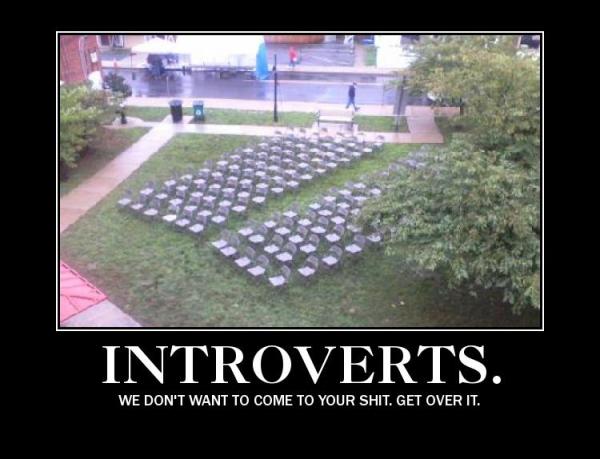
In the mean time, enjoy a meme I made some years ago that, if you are an introvert I am sure you can relate to. Happy World Introvert Day.

 Ty Unglebower