Part Time Job
Over the last few weeks, my blogging schedule hasn’t been quite as regular as it normally is, or as I’d like it to be. That’s because I recently started a part time job as an assistant housekeeper at a local assisted living home. My mother is the head of housekeeping there. She’d been needing some help as her workload has increased somewhat over the last year for various reasons. Plus extra money is good. (But the main reason I took the job is to make my mother’s life easier. But don’t tell her I said that.)
By and large I am happy with the job. It’s only a few hours a week, but for most of those hours, I’m left to my own devices. If you know me, you know that’s a huge plus. And if I do need help with something, I need only seek out my own mother.
There is a certain satisfaction to making something clean that starts out dirty. I particularly enjoy vacuuming carpets for this reason; dirt is there, I move a machine around in a regular, almost meditative pattern, and moments later dirt is not there. Same with wiping down the windows, or cleaning up the metal elevator.
There’s a task that’s in many ways suited to my brain, cleaning elevators. Alone in a quiet box, making a collection of metallic rectangles as shiny as possible. (Okay, there are some wooden parts to one of the elevators, but my point is the same.) There is also a remnant of childlike appreciation with my mind for elevators. I think every parent at some point has to tell their kids to quit playing with an elevator: Don’t push all the buttons at once. Get out of the way, people need to get in there. Stop sticking your hand out to make the door open again.
When my sister and I were young and Mom would take us on vacation, one of my favorite things to do was go on the elevator to the high floors of the building, (where Mom would never book a room) and come back down. She’d let us do that sometimes.
All by way of saying, unless they suffer from claustrophobia, I dare say most kids love elevators for whatever reason, but in many cases don’t get to use them unless they have some reason, or very lax parents. Adult me now gets to go in and out of an elevator any time I damn well please. Actually, I usually take the stairs for fitness reasons, unless I have a lot of cumbersome items I need to move, but the point remains.
Yes, I do clean bathrooms. I doubt anyone looks forward to cleaning bathrooms, but I don’t dread it either. It is what it is, and it’s only part of my job anyway. I admit, probably my least favorite part, but I get to do them on my terms at least. Chemicals bug me a bit at times, but we have organic stuff I use too, which isn’t as bad.
I mentioned the motion of vacuuming being meditative before. You won’t have to research long to find all kinds of traditions in various religions about meditative cleaning. It’s a mindfulness thing. Cleaning and picking up keeps you right in the present. My particular mind still wanders and worries far more than it should even when I am on the job, but the nature of my tasks do afford me the chance to practice mindfulness and presence, which i do.
And of course, the residents. I don’t do much directly with them, though naturally I see them all the time, and I’m cordial with most. They always get the right of way in the hallways. That’s how I prefer it. It’s there home, after all. I try to remember that in everything I do; people live there.
And of course, people die there, as happen just last night. Actually, the resident died after a brief stay in the hospital, but I was present when the emergency vehicles took her to the hospital. That particular woman stayed mostly to herself, but I do recall seeing her here and there. An odd thing to get used to, the near-expectation of death “before long” in such places. The quickness with which everything is normal after it happens throughout the place.
But it’s not a place of death. The residents are on varying levels of functionality. Some are healthy, but just retired. Some in wheelchairs, and one that never leaves her room. (I don’t go into private rooms, as my domain is the public spaces.) But those that live there play games, watch movies. Even exercise. I admit I thought I might find working there depressing before I started, with so many people that have health issues. There is a tiny fraction of that, but mostly, it really is just a place people live and work, like so many others all over the world. One small community, part of a larger one, which is part of a larger one, and so on in the obvious outward spiral.
I think about that spiral particularly on days when I am outside doing work. Most of what I do is inside, but I have a few outside tasks, one of which is to bring in the large trash cans once a week. The person walking their dog, the car driving by, people walking into their jobs in the building across the street. A mosaic of “alive” of which I am a chip. I have always been so of course, by virtue of my being human, but I am somehow more aware of is as the scraping of the trash cans wheels on the brick walkway in front of the home echoes through the block as I drag it through the morning sunshine and toward the back of the building. Pull up, and I am visibly one of the cogs in the morning machine that cranks out a day in the city. It’s all sort of Walt Whitmanesque in a way.
I’m a writer and an actor. I imagine I will always be so, in one way or another. Those are my callings, and I make money doing them, here and there. I don’t imagine I will still be a part time housekeeper 30 years from now. Yet today, and for the foreseeable future, I am an artist making some money at a job not connected with my calling.
Or is it? Are not the concepts of story, character, expression, art, service all at play during the few hours a week I clean the public areas of that home? They are. My preferred form of them is the stage and page, but I’d have to be an elitist or a fool to believe they are absent during my part-time gig.
Cover Reveal: “Murder. Theatre. Solitaire.”
Okay, so here it is! No countdown, or contest, or giveaway or anything of that nature. I’m just happy to share with all of you the official cover of my upcoming murder mystery novel.
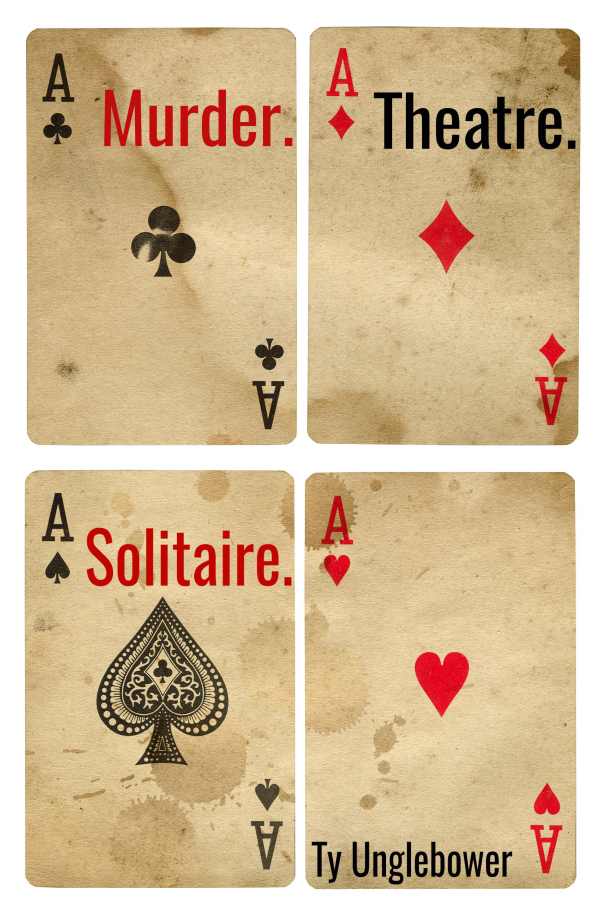
Pretty cool, right? And simple. Or cool because it’s simple.
The cards were a pre-existing stock image. The words, obviously, are my additions.
I tried many variations on font and size, all of which had their charms. But after consulting with friend (and designer of my two previous covers) J. Lea López, this one came out on top.
Without giving away plot points, I like to think the title with this cover sheds light on the major aspects of the book a reader can expect to find. (A theatre director who enjoys solitaire gets tangled up in a murder mystery, and uses his theatrical perspectives to try to solve same.)
I’m happy with how much I’ve learned about designing a cover myself this time around. I grant you, it makes use of the stock image. But compared to what I understood of the mechanics of this sort of thing last year, and the year before, I’m much further along the indie publishing journey this time, insofar as how much I have done on my own. I’m not saying I’ll do it all by myself for every single cover from now on, but there’s a certain satisfaction in doing so this time.
As for the book itself…no release date yet. I’m still aiming for early summer, but I wouldn’t want to announce and have to take it back. But I would call this the home stretch. I want to tidy up a few scenes, and add an element or two here and there. Plus one final review for errors, and it will be ready for formatting and publishing.
By all means, stay tuned!
Writers Must (NOT) Read.
Okay, that title is sensationalism at work. Of course writers must read. Most of the time. And I do.
Among the single novel I try to always have going, and the single non-fiction book I have going at the same time, any given moment I’m also reading short fictions, poems, and articles and or blog posts from fellow bloggers.
Many of those posts are about writing. I subscribe to the feeds of several writers’s websites. Some posts I find via Twitter as well. Writing is a lifelong process, after all-a craft that is never truly mastered about which every honest sincere writer is always learning.
Yet just as some people take social media breaks, I’m considering an advice break.
There is great writing advice out there, but direct and indirect. Many sources from fellow author’s offer a great deal to their colleagues. I myself try to do this here on my blog on a regular basis. O hope some things I’ve said here have helped at least some of you some of the time.
Yet, reading about writing isn’t the same thing as actually writing. Reading about the art of writing, the marketing, the lives of words of successful authors is often an unconscious stalling tactic. Would-be writers spend all of their time reading about the writing life, and almost none living it.
This isn’t me, by the way. I continue to make steady progress on my writing goals, such as my upcoming mystery novel, this blog, and my freelance work. Not to mention private practice and journaling and such. I’ve not neglected my actual writing. Still, I sometimes wonder if I don’t need a break from all of the advice, the shared stories, the observations from other writers at different stages of success. Mightn’t the time I use making my way through my feed be better spend creating even more writing?
The answer is “perhaps.” I maintain that writer websites and articles therein are not only fun, but valuable resources of knowledge and guidance. But I don’t want to push it.
So, just to do an “advice cleanse” if you will, and dive more into what i already know and have already discovered as I write, I won’t be reading my writing related blog feed again until the end of April. Not on purpose, anyway. I’m sure I’ll slip up here and there, but I’ve announced my intention.
I will spend the time I would have spent reading on writing, of course, but also submitting. I’m behind on that as well, as per my own stated goals.
So, I’m off to read my feed for today, and begin my advice-free April. (Plus a few days in March.)
I’ll keep you posted on how it feels to isolate myself in this manner.
Beware Your Ides of March
“…as he was ambitious, I slew him.” –Brutus, Shakespeare’s Julius Caesar, Act III.
Old Julius had his chance, didn’t he? At least in Shakespeare’s telling of said tale, a soothsayer told him to beware the Ides of March. But did Caesar listen? No.
He feared nothing, or claimed to fear nothing because he was Caesar, simple as that. Obviously that didn’t turn out well for him.
Yet one could argue he wouldn’t have been in that position so many March 15ths ago, had he not been overly ambitious, in his case for power and importance in Rome and beyond. He wanted to be a king eventually, and felt he deserved to be so, that he was qualified for such a position, he that had accomplished so much.
The forces around him didn’t agree.
Ambition in this country is seen almost as the primary virtue. The desire to advance in wealth, prestige, power, accomplishment is almost a molecule in the American DNA. It’s also a building block of advice within the world of writers.
“Get interviews, sell you book out of your car, hire publicists, get yourself out there, study the trends, go to conferences, remember to write something that can be made into a movie easily when you go to sell the movie rights. (And of course you do intend to market and sell movie rights to your work don’t you?)”
Ambition for the writer, or for anyone isn’t evil in its own right. We all need some of it, of course. But ambition is often conflated with persistence these days. The later is vital for success in writing and most other things. Ambition is secondary. If we’re not careful in fact, too much ambition is deadly.
Believe in yourself as a writer, naturally. Be proud of your work. Strive always to improve. But do so in pursuit of being a better writer, and contributing something to the world. Be willing to enjoy the accomplishments of today,before declaring where you want to be a year from now, (or further) lest the fall should be more damaging when we trip up, or don’t attain what we declared we desired so deeply.
Writing is a competitive field, yes. You always have to fight for the attention of readers. In this day and age of self-publishing that is an increasingly unlikely task. But the same zeal that could put you on top can always keep you from it.
Yes, there may be people out there who sabotage us when our ambition grows too large for our resources, but often enough we are our own undoing. We play the Brutus to our own Caesar, whether we realize it consciously or not. We juggle eggs at first, than knives, and despite a few cuts, we think we can handle chainsaws next.
You don’t need everything today, or even tomorrow, or next week. You’ve gotten this far, and you will get further, but don’t insist on taking from the world what it may not yet be ready to give to you. By all means work hard, push your boundaries, but don’t, like Caesar, assume that because of what you’ve done or who you are, you deserve to be crowned by society. You not only have work to do, but respect and temperance to display.
Of course, overnight, ambitious success stories happen, and I can’t swear you won’t be one of them by ignoring everything I just said. I do believe, though, that if you do too much inner horse trading with yourself, and with others in order gain more and more in less and less time, you’re likely to see yourself as more of a manufacturer and less of an artist. You run the risk of slicing your artistic heart right out of you, whether you succeed in your ambitions or not.
And that, friends, would be the unkindest cut of all.
“Murder, Theatre, Solitaire” Update
The fourth revision of MTS is well underway. This is a “read out loud” revision. I think a cozy mystery such as this is probably best served with sentences that are shorter and faster than much of my other writing, so I’m listening carefully to diction and such.
I just have to make sure I don’t edit out any of the clues!
I have one or two concepts I need to research for accuracy. I feel confident that I’ve gotten them right, but I want to be sure, because science. There isn’t much straight up science in the story, but if I mention it, i want to get it right, or at least structure it in a manner ambiguous enough to not be flat out wrong.
There are also some places where I want to foreshadow something more so than I have done so far. I of course don’t want give away the store too early.
Editing and revising a mystery novel feels different than doing so for Flowers of Dionysus. No doubt part of it is that I am now more experienced. Plus my first novel was a fantasy, and this is a murder mystery. But what is it about a murder mystery that makes the process seem so different?
All stories are to a degree, a web. Even if told in chronological order, aspects and scenes touch each other in more than one way. That was certainly true for Dionysus, even though the events were told “in order.” The events of MTS are also told in order, but because of the nature of the genre, a lot more has to touch on multiple angles and possibilities, some of which are not clear until near the end. (As any good mystery should be.) Revising my first novel was like folding a paper airplane. Revising a mystery is like folding an origami bird; every crease takes on more responsibility to the whole, so I have to be tighter.
The analogy isn’t perfect, but it’s the closest I can come.
I’m also playing around, in a very broad sense, with designing my own e-cover. I know, most people are against that, and it may come to pass that I give up on the process, and rely on someone else once more. But everything is getting done earlier in the process this time, and I have plenty of time between now and my planned launch in June to mess around and see what I can do, and still have time to get bailed out as needed by someone who knows what they are doing.
Right now, I am maybe a fifth of the way through the book in this revision. I think only one more after this should suffice. Two on the outside.

 Ty Unglebower