You’re Better at Revisions Than You Think
Cutting your manuscript for length may not be as difficult as you fear.
Yes, there is the concept of “kill your darlings” that you have probably heard somewhere around a billion times in the writing world. In other words, so goes the advice to writers, be prepared to save your manuscript by removing sentences, pages or even entire plot points from your fiction with which you have fallen totally in love. Afterwards, prepare to feel and accept the resultant sucking void left in your soul for years to come.
Okay. While we’re at it, why don’t we just go ahead and explain to the world that only rough drafts written with quill pens in our own blood are sufficient to express true devotion to our craft?
The truth is, you probably will have to get rid of parts of your drafts that you like. That’s the nature of revisions and editing. It’s all part of making your manuscript as tight and compelling as possible, yes. I concede that.
Yet if you are so in love with a section of your novel that the thought of excising it keeps you up at night, that’s a decent sign that it ought to stay in the manuscript.
Further, the “kill your darlings” approach, while in some ways accurate and well meaning seems to declare that no writer ever truly wants to get rid of anything they have written, and that simply isn’t true.
My debut novel, Flowers of Dionysus is just over 85 thousand words. The first draft came in at about 120 thousand. I knew even before I finished that I would have to cut that down for the second draft. I did, and you know what? A lot of it was pretty easy to say goodbye to. It was logical to write it in the moment of creation, but it took only one reading of my entire rough draft for me to realize that hey, this doesn’t add anything to the narrative, and further, isn’t even interesting in its own right. I removed a whole chapter at one point, and instead of it feeling like I was killing my darlings, it was more like politely declining to take a door-to-door survey from some out of town marketing stooge that got my address from a list.
In other words, it didn’t cause a lot of distress.
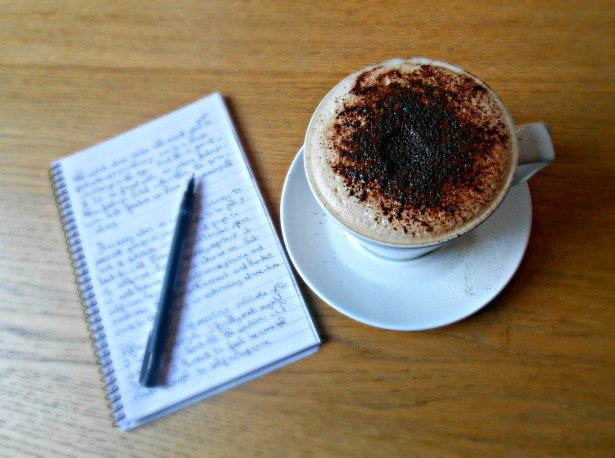
“This is my fourth cuppa, and my tenth lousy prologue of the day.”
If you are thinking of writing something for the first time, know that you are a better judge of what must go in revisions than you may think. And if you have ever written anything ever, I am almost certain you have cut at least a few things out of a draft at some point, and never gave it a second thought. Beta readers and editors can be vital to our success, but don’t discount the possibility that you yourself will catch much of your own literary bloat in the early drafts.
Yes, there are some out there who write entire manuscripts without stopping, and when finished can’t bear to part with a single word. We call those people hopeless, or if you prefer, delusional. For the rest of us, we’ve got a built-in sense for what has to go from our own creations, and it’s okay if we don’t shed a tear when we do so.
Dismissing something from your manuscript with ease is not a sign of a lack of passion for your story because not everything you write is a gem. (Shocker.) If anything, be able to make painless cuts early on is a sign of maturity in a writer.
The Return
I am back from my brief hiatus. Since my last blog post, I got my first ever smart phone (I know), my sister and her daughter visited the house, I finished watching a series of 48 lectures on DVD about ancient Egyptian history that I bought from The Great Courses, had dinner with a friend, and met up with my Social Introverts meetup group. (Most of whom that week were totally new to the gathering.)
Somewhere through all of that, I had time to clean, and do some fiction writing, as well as some often-neglected journal writing.
Doesn’t exactly sound like the time off I suggested it would be a week ago Thursday, does it?
And yet, despite the various things going on, it was helpful to be “off.” To simply experience the various activities without calculating when and how to do something else was helpful. Presence. Such a key to good communicating and writing, yet something we busy or restless writers often forget to embrace. I wasn’t a Buddha last week, but I was on a somewhat different wavelength as I pursued my commitment of “not working.”
Not only did I not blog, but I had no freelance pieces to work on during last week. As a result, there was no looming deadline for either myself or anyone else for which I write. As a result, different sorts of thoughts and ideas entered my mind not only for potential future writing, but for the nature of current WIPs.
Not that I chased ideas, as that would have defeated the purpose of the time “off.” I was to worry or plan nothing in particular for that week, even with my writing. I kept to that agreement with myself. Yet some potential stepstones, or broader ideas did float down the stream into my view a few times.
No epiphanies, per se. Yet taking the pressure off of certain parts of my mind for a week allowed energy to flow in some slightly new directions, to take a few off-roads within my imagination as it were. This can and should be done anytime, vacation or not, and with some time, I do. I just found I didn’t need a GPS as much to get there during my week off. (Metaphor beaten senseless as of now.)
All of this means of course that several things are due this week, and I have a few other things that must be taken care of as well. Isn’t that always the way when your hiatus is complete? Yet I plan to take shorter hiati (?) more often going forward. I’m coming up on a bunch of things that need consideration and work and reflection, both in my writing world and outside of it. To get the best out of it, I may have to force myself to take 2 days off here and there between so called “vacations.” I think I can convince myself to allow this, if I consider that my writing and perspectives will improve overall.
If you can’t take a week take to days, or one, in which you do and plan nothing. See what it does for your writing, both while you are off, and after you come back.
Off Next Week
Not that I feel anyone sets a schedule based on my publishing posts here on the blog, but as a general matter of courtesy I wanted to mention that I’ll be taking next week off from blogging. (Unless something really great happens unexpectedly, I suppose.)
This is a medium-sized deal, because I don’t think I’ve ever taken a week off officially. I’m actually fairly proud of how regular I am with posting here just about every Monday and Thursday. (Though I miss Thursdays far more often than Mondays.) I “feel” the expectation to post here each week. That is to say, it has become habit, and that’s a good thing for any type of writing, I would think. Regular writing of some kind benefits all types of your writing.
But so does taking an intentional break from even regular stuff such as this blog, hence this decision.

Very little chance I’ll spend my week off like this.
My parting advice for over the next eleven blogless days is that you also remember to take a break from your regular routine(s), even your writing. We’re all people, and we need to be refreshed occasionally, even in our vocations and jobs.
So, I’ll see you a week from Monday.
Yes, I Want People to Read My Writing
Imagine a chamber where every last possible aspect of writing is discussed by someone. Many someones in fact. This isn’t an organized chamber run by Robert’s Rules of Order, oh no. It’s a place where writers expound upon writing itself. Imagine Raphael’s The School of Athens, with less organization and more laptops and coffee.
Many in the chamber shout (or tweet?) about how money is the idea of writing, like any other profession. You write things that can be sold, and draw a profit. It will seem like the chamber is full of those types, because they shout louder and more often.
But there’s another group, quieter but no less insistent. They expound upon the glory if not the euphoria of creating words, sentences, plots and characters out of nothing and into nothing, (that is to say, not caring at all if anyone reads them.) Some even write with the intention of nobody ever reading what they write. They are artists, dammit, and they are moved by spirit. How gauche in fact, to write something with hopes that people will ever read it.
Then there is a minority within the chamber. Some are louder, some are quieter. Some hand out pamphlets to the distracted multitude while others engage in subdued conversation with a few others of their ilk in the corner of the chamber. Their expressed viewpoint is not exactly rare within the chamber of writers and their advice to the world and one another. Yet they don’t seem to get as much airplay, as it were. When I summon up the stomach to enter that grand chamber of advice and counsel, I am in this group, though I don’t hand out pamphlets.
What is this group? What do we say? We say:
It’s okay if a writer wants his work both read and enjoyed by other people, so long as it’s authentic.

“Art thou plotter or pantser?”
Yes, at first this view seems to be a mashup of the other two I’ve mentioned. We write how we feel we must, and we still want a lot of people to read it. So we can make money, right? So we can crap on the establishment, right?
Not really. And, not really.
We need money like anyone else does. We’d be thrilled if we could someday make money. But I write this blog in hopes that someone will read and enjoy the posts, and I make no money from it. I create content here simply to share thoughts, and perhaps make others think, or sometimes to entertain.
And my novel? The same thing. It means something to me, and though I tidied up the structure and language in places based on advice from smart people here and there, overall the book is mine, true to my vision of it. I’m not going to turn down money, or course, so long as it is legal money. But I wrote a book because I want people to read it any enjoy it. I charge for it because it took a lot of work, but I created it in order to share an idea. A story. In some ways, to share my love.
I market the book, or I try to. I want more people to buy it than have bought it so far. I’m studying how to achieve that. Of course I want and need money for it, but in the end what i am truly marketing is a story that i want people to enjoy. If a thousand people read the book for free and loved it, felt moved by it, I believe I’d be happier than if 200 bought it, and either hated it or said nothing at all about it. I want people to enjoy my writing, call me crazy.
Yet I am not crazy, and neither are you if you hope lots of people will read what you’ve written, whatever it is. I’m not knocking you if you’re only in it for the money, (though good luck…) and I am not judging you if you write 100% for yourself, never wanting anyone else to read what you’ve written. Yet if you find you are like me and the rest of that minority in the chamber, and you write first and foremost because you want other people to enjoy it, don’t let your view get shouted down by advice. Leave the chamber if you need to, but hold on to both loving you work, and wanting other people to love it.
You are no less a writer for feeling that way.
Rewrite Somebody Else’s Stuff
Need some writing practice? (Who doesn’t?) Want to keep the imagination warm without wracking your brain to come up with a new concept or project? Rewrite somebody else’s stuff.
Of course don’t try to publish the result unless your source material is in the public domain. Even then, however, I think the experience would be more rewarding without a mind toward publication. Experimentation is bolder that way.
I don’t mean fan-fiction, wherein you write your own adventures of previously establishes characters and settings, though that’s also an exercise worth looking into for some people. Nor do I mean tweaking classic stories into outlandish worlds, though of course, you can do that do, if that’s your thing.
What I mean, though, is choosing a story or novel that already exists, and transposing it, if you will, into your own voice, your own style; different aspects of the creative juices are sampled when one adheres to the original plot, settings and characterizations and recreates them in a different style. (As opposed to a different genre.)
It doesn’t make a damn bit of difference if the prose you use doesn’t fit in with the time period, just go for it.
And don’t simply interpret your source text in a modern fashion. That would sound choppy and serve less of a purpose.The point is to internalize something enough to recreate it’s tone and plot in your own words, without losing the essence.
Consider:
1) “First things first; Marley was dead. You have to understand at least that much up front, or nothing I say from now is going to mean much.”
2) “I don’t know why exactly, but lately I feel numb. I’ve got no motivation to take up space in my own life. It’s gotten so bad that this enormous planet is now an empty rock to me, and the awesome sky above it amounts to little more than a collection of swirling almost poisonous gases.”
3) “Once, I became disoriented in the midst of a rather threatening, dark woods, the obvious path no where to be found. God, the place was so bizarre, dark and eerie that I get scared all over again just thinking about it.”
Do this, if not for an entire work, (though what an adventure for you that could be!) at least for more than a few sentences. Not only do you stand to gain a stronger understanding of your own writing, but perhaps a greater appreciation for the original work as well.

 Ty Unglebower